
WATCH THE VIDEO 📹
LISTEN TO THE PODCAST🎙️
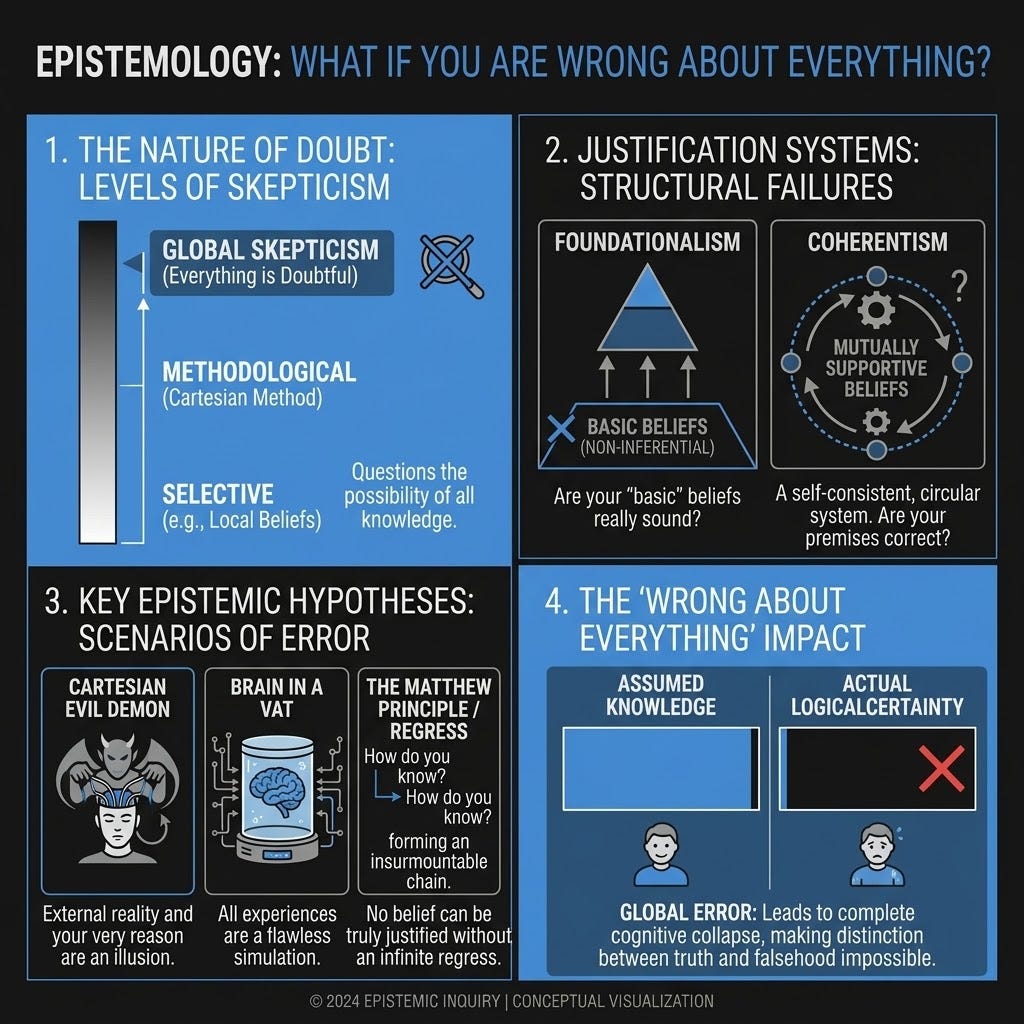
We all assume we’re right. That’s the quietest, most dangerous assumption we make. Every argument you’ve ever had, every decision you’ve ever made, every belief you hold — it all rests on the assumption that you know what you’re talking about. But here’s the question that unravels everything: how do you know? Not what do you know, but how do you know it? That’s the question of epistemology, and it’s not just for philosophers in ivory towers. It’s the most practical question you’ll ever face.
The Elephant in the Room
Here’s the thing about knowledge — we all think we have it, but most of us have never actually stopped to ask where it comes from. We’re like fish trying to describe water. We’re swimming in it, but we can’t see it.
Philosophers have wrestled with this for millennia. How do we know what we know? Is it through our senses? Our reason? Our intuition? The big names in philosophy — Descartes with his radical doubt, Kant with his categories, Hume with his skepticism — they all took a swing at it. And honestly? They came up with some clever theories. But they all hit the same wall.
Here’s the problem: if knowledge comes from the world around us, then knowledge is only as reliable as our ability to perceive it. And anyone who’s ever seen a magic trick knows our senses can be fooled. If knowledge comes from reason, then we need to justify reason using reason, which is like pulling yourself up by your own bootstraps. It’s circular. It’s a dead end.
The modern world has decided to just give up on certainty altogether. We live in a culture that says truth is relative, that your truth is true for you and my truth is true for me, that the only thing we can’t tolerate is someone claiming to have the truth. That’s the ultimate sin in our culture — claiming to know something for sure. We’ve built an entire society on the shifting sands of “I feel” and “I think” and “it’s true for me.”
But here’s the thing that keeps me up at night: if you can’t know anything for sure, then you can’t know that either. The person who says “there is no truth” is making a truth claim. The person who says “you can’t know anything” claims to know that. The entire worldview collapses under its own weight. It’s self-refuting, and yet we’ve built our entire culture on it.
The Foundation Beneath the Foundation
So what if we’re asking the wrong question? What if we’re so busy looking for the answer that we missed the fact that the answer was right there all along? What if certainty doesn’t come from finding solid ground, but from knowing the One who is the ground of all being?
The book of Proverbs says it this way: “The fear of the Lord is the beginning of knowledge” (Proverbs 1:7). Not a part of it, not a helpful starting point, the beginning. The word used there in Hebrew, reshit, means the first, the chief, the most important part. The foundation. You can’t have knowledge without it, is what he’s saying.
And that makes sense when you think about it. If there’s a God, and if He created everything, then everything finds its purpose and meaning in relation to Him. A fish doesn’t know it’s wet until it’s out of water. A human being doesn’t know what knowledge is until they stand before the source of all knowledge. The Bible says we were made in His image, which means we were made to know Him. And when we know Him, everything else clicks into place. When we don’t, everything falls apart
The God Who Reveals
Here’s where Christianity completely changes the game. Every other worldview has a system of knowing that depends on human effort. You have to be smart enough, or good enough, or enlightened enough to figure it out. You have to climb the mountain of knowledge yourself. But Christianity says something radical: God comes down to us.
We don’t have to reach up and find God through our own intellectual effort. He’s revealed Himself to us. The Psalmist says, “The heavens declare the glory of God; the skies proclaim the work of his hands” (Psalm 19:1). Paul tells us that “since the creation of the world God’s invisible qualities—his eternal power and divine nature—have been clearly seen, being understood from what has been made” (Romans 1:20).
God has revealed Himself in creation, in His Word, and ultimately in His Son. “In the past God spoke to our ancestors through the prophets at many times and in various ways, but in these last days he has spoken to us by his Son” (Hebrews 1:1-2). Christianity isn’t a system of knowledge we discover; it’s a relationship we receive.
The Apostle Paul called it a mystery that has been made known: “Christ in you, the hope of glory” (Colossians 1:27). The Creator of the universe didn’t just give us a book and say, “Good luck with that.” He gave us His Son, and He gave us His Spirit, so that we could know Him. Not just know about Him, but know Him. Intimately. Personally. Truly.
How to Actually Know Stuff
So what does this mean for how we live our lives? It means we can have confidence. Not arrogance, but a deep, settled assurance that the God who made the universe is not playing hide-and-seek with us. He wants to be known.
First, we have to be willing to know. “If anyone chooses to do God’s will, he will know whether the teaching is from God” (John 7:17). There’s a moral component to knowledge. If our hearts are set on our own way, we won’t recognize the truth when we see it. But if we’re willing to obey, God will show us what’s true.
Second, we have to ask. “If any of you lacks wisdom, you should ask God, who gives generously to all without finding fault, and it will be given to you” (James 1:5). God is not threatened by our questions. He’s not scared of our doubts. He invites us to ask, to seek, to knock.
Third, we have to build our lives on the Rock. Jesus told a story about two builders — one who built on sand and one who built on rock. The one who built on the rock was the one who heard Jesus’s words and put them into practice (Matthew 7:24-27). Knowledge isn’t just about information; it’s about transformation. It’s about taking God at His Word and living like it’s true.
The Truth That Sets You Free
Here’s what I want you to take away from this: you were made for certainty. Not the fake, arrogant certainty of a know-it-all, but the deep, abiding confidence that comes from knowing the One who is the Way, the Truth, and the Life.
The world will tell you that you can’t know for sure. They’ll call you closed-minded for claiming to have the truth. But the opposite of faith isn’t doubt — it’s certainty in the wrong thing. Faith is being “sure of what we hope for and certain of what we do not see” (Hebrews 11:1). It’s a confidence that isn’t based on our ability to figure everything out, but on God’s character and His faithfulness.
So stop trying to figure it all out on your own. Stop trying to build a foundation on the shifting sands of human opinion. Stop being blown around by every wind of teaching. Instead, build your life on the solid rock of Jesus Christ. He is the same yesterday, today, and forever (Hebrews 13:8). He is the way, the truth, and the life (John 14:6). And He is the only foundation on which true knowledge can stand.
Everything else is just sand.
5 Common Questions
Q: Is it arrogant to claim you have the truth?
No, not if that truth is grounded in humility. The Bible says Jesus is “the way, the truth, and the life” (John 14:6). It’s not about being smart enough to figure it out; it’s about being humble enough to receive what God has revealed. The proud person says, “I have no need of God.” The humble person says, “God, show me your ways.”
Q: Can I really know God personally, or is that just religious talk?
I know it’s a cliché, but it’s true — knowledge isn’t just about facts, it’s about relationship. You can know about a person, but to know them means you have a relationship with them. The Bible says we can have that with God through Jesus. He’s not distant or aloof; He’s a Father who wants to know His children. That’s the whole point of the Gospel.
Q: What about all the smart people who don’t believe in God?
Paul addresses this directly in Romans 1. He says that God’s invisible qualities are “clearly seen” and that people are “without excuse.” The problem isn’t a lack of evidence; it’s a heart issue. The Bible says that “the fool says in his heart, there is no God” (Psalm 14:1). That sounds harsh, but it’s a description of the intellectual and moral rebellion of the human heart, not a commentary on someone’s IQ. We don’t need more information; we need more humility.
Q: What is the difference between knowledge and wisdom?
Knowledge is the accumulation of facts; wisdom is the right application of those facts. You can have a lot of knowledge and not an ounce of wisdom. But the book of Proverbs says, “The fear of the Lord is the beginning of knowledge” (Proverbs 1:7). It’s the starting point. When you have a right relationship with God, you have the foundation for true knowledge and the discernment to use it rightly.
Q: What if I have doubts?
Everyone has doubts. The question is what you do with them. Don’t let them drive you away from God; let them drive you toward Him. The father in Mark 9 cried out, “I do believe; help me overcome my unbelief!” (Mark 9:24). That’s a prayer God can answer. Bring your doubts to the cross, lay them at His feet, and ask Him to help you. He is faithful.


