
The truth is the answer highlights why so many of our earthly discoveries are buried deep inside the Earth’s crust with the exception of a select few.
What You Will Learn
What is the survival rate of physical artifacts or chemical signatures of civilization after a billion years of erosion and plate tectonics?
What kind of evidence will survive a billion years of erosion or plate tectonics?
Why would any isotope ratios or synthetic material in the crust be a sign of civilization?
How would we distinguish artificially created elements from naturally created ones?
What does this say about our search for evidence of aliens?
The Problem: All Things Get Destroyed
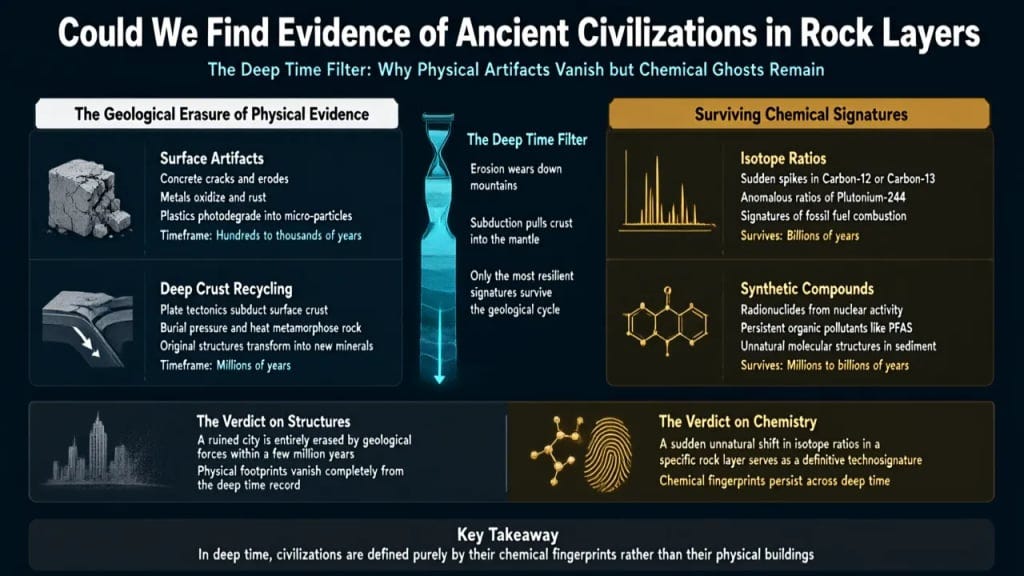
Begin by acknowledging a hard truth, the Earth is actively hostile toward evidence. Plate tectonics shuffles the continent around while erosion wears things down. With time, the effects of burial pressure and heat transforms rock deep underground. After a billion years, the evidence of most discoveries will have been worn away or turned to stone deep underground.
Take an example of a city. After some time, cracks will begin to appear in the concrete, the metal will rust, the plastics will degrade, and after just a few hundred years in this hypothetical scenario, the whole city will have turned to rubble. Now extrapolulate this idea to millions or billions and you begin to appreciate the fragility of the physical structures.
The Good News: But, There Are Exceptions.
Geologists have discovered chemical features that have lasted up to 3-4 billion years. These chemical signatures and the mineral structures they form are strong enough to survive billions of years of erosion. What this means is a civilization would leave behind similar chemical signatures, synthetic polymers (plastics) which are unique to their creation process, or unique isotope ratios which if unearthed, are fairly easy to identify as man-made.
However, the issue is not so much with the discovery of evidence, but being able to discern the difference between naturally occurring phenomena and artificially created materials
.
How We Distinguish the Two
Most geologists are already well-versed with distinguishing naturally occurring elements from artificial ones. The tell-tale signs for the presence of artificial isotope ratios are patterns that do not appear to come from anywhere. When they do, they will investigate it. In fact, the exact same principles apply in discerning evidence of a billion-year-old civilization. The evidence, if found, will stand out. Either as a peculiar isotope ratio found in a strange deposit or as a unique mineral structure. It will be impossible to mistake an isotope ratio for something it is not if it does not follow the laws of chemistry. Likewise, it will be fairly easy to discern evidence of industrial activity from natural formations. The evidence of this activity taking place would most likely appear as some sort of sediment deposit.
What This Tells Us About Time
What this teaches us about deep-time, is that a billion years is a very long period of time and although civilization has the capacity to endure, it does not have the capacity to resist destruction, especially on a planetary level. Every hundred million years or so, the planet changes and the old structures are swept away, buried underneath sediment, or transformed into deeper underground rock. Yet, the signatures of chemistry can be read by people who know what to look for. That is why the Biblical message of creation is so important, because it grounds humanity in a God who created not only the universe but the laws of science which govern it all. “In the beginning God created the heavens and the earth” (Genesis 1:1). The natural world functions the way that it does because it was created to function that way.
What You Learned
Most surface structures would have been worn down after a billion years, but chemical or isotope signatures could be found in the Earth’s crust
Evidence of synthetic polymers and abnormal isotope ratios would be found in sediment deposits.
Distinguishing artificial evidence from natural evidence would not be difficult since the former would not follow expected patterns
Geologists already have ways of distinguishing naturally occurring evidence from artificial ones.
Deep time shows us how long the planet has existed and how much change it has undergone
My Thoughts


