
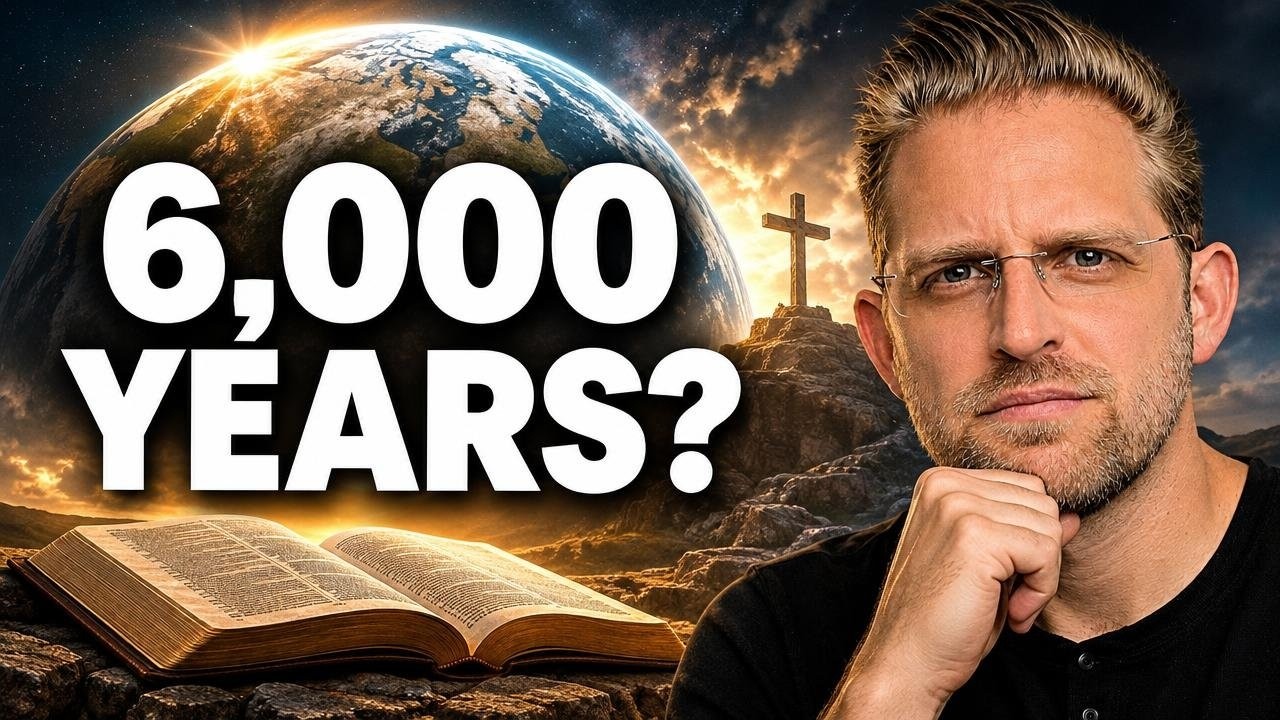
Does the Bible Really Say the Earth Is 6,000 Years Old?

SUBSCRIBE TO CHRIS'S BIBLE NEWSLETTER
FULL BIBLE STUDY ARTICLE
Listen to the Podcast
Support the Newsletter
My Book Recommendations
Navigating the debate between science and scripture. The age of the earth. This is one of the most divisive, controversial issues among Christians today.
Some maintain that the Bible, it teaches a young earth where others believe the Bible teaches an old earth. Which side is right? Does it even make a difference when it comes to your faith?
Okay, we're going to answer these questions. What are we going to cover in this episode? The core claims of the young earth view which are interesting.
Even more interesting, the core claims of the old earth view and how these contradict each other. What the Bible says about creation days. We're going to discuss science and how this fits into the view.
And then ultimately why this debate is important to your faith but not hinging on your faith. Okay. So, if you believe young or old, both of those can still work for your faith.
we're going to go over some practical applications as well. Stick around. Each section will build.
At the end, we sort of recap everything. We tie everything together. but let's get started here now with the core claims of the young earth view.
Okay. What are these? The young earth creationists or YEC take a literal interpretation of Genesis in Exodus 20 11.
What does it say? In the six days, the Lord made heaven and earth and believe that God created the universe in 6 24-hour days. So, they add up the genealogies found in Genesis 5 and 11, conclude that the universe is approximately 6,000 years old.
According to the YEC, the deluge of Noah caused the earth's present geological formation. So the flood that occurred in Noah's time caused the formations. One of the one of the main points of young earth creationist is that scientific findings can be reinterpreted to find concordance with scripture.
Understanding the Biblical Account
So an example of this is the young earth the young universe explanation for the light from distant stars that reaches us on earth. Okay. So let's take this and go a little bit further.
What are some core claims of old earth view and then we'll start to tie these two together. and you'll start to see the correlation. The old earth creationist or OEC believe that the universe is billions of years old but God created it.
So the OEC interprets the days of creation found in Genesis as either long stretches of time, day age view or figurative language like a framework view. They also believe that the psalmists a thousand years are but as yesterday when it is passed. We see this in Psalm 90:4.
So what does this mean? This is God's way of saying that time is relative to him. So old earth creationists believe scientific findings about the age of the universe and the mechanics of how life works on earth are generally compatible with scripture.
They believe God used an evolutionary process to create the different forms of life. Okay? So hold on to those two.
And now let's talk about what the Bible says. And and we're going to touch on Genesis 1:1 and12. And you'll see how this is interesting.
What the Bible says about creation days. The Hebrew word for day is yam. It can mean time, daylight, or a 24-hour period.
Context is needed to determine which meaning applies. So in Genesis 1, God worked for six days of creation and rested on the seventh. But each day he created ended with evening and morning.
It could mean a 24-hour day, but the writer probably did not mean literal days since the sun was not created until the fourth day. See in verse 19. So, another possible interpretation is the gap theory.
Biblical Foundations of Morality
Examining the Scriptural Evidence
This suggests there was a period. This is interesting. Before Genesis 1:1, when God prepared the universe for Jesus, the Bible does not give us the exact age of the earth.
The genealogies might skip a generation or two here. But understanding this between Genesis verse 1 and one two there is no time. So the earth could be bill it could be billions of years there.
It could be hundreds of years, thousands of years. There is no way we know that for sure. Now, you can trace back genealogies once you get into Genesis, but that still doesn't give a definitive on the Earth's age.
so understand that. I would encourage you to look into that a little bit further if you're interested. And also too, please leave your thoughts in the comments on this.
let me know what you think. Are you old Earth? Are you young Earth?
And why? Now, how does science fit into each of these views? Okay, before we wrap this up, science dictates the universe is approximately 13.8 billion years old and the earth is about 4.5 billion years old.
Okay, so young earth creationists would take issue with the methods used in determining these numbers and why it is based on a uniformitarian perspective. What does that mean? The proponents of the young earth also use scientific findings.
And what are these? They're the existence of soft tissues on dinosaur bones to support their view. The old earth creationists takes a more pluralistic approach by saying the findings are undisputable and are God's way of creating the various life forms on Earth, including humans.
So both sides here are using science to prove their viewpoints, but the scientific data does not tell us what to believe about the creation account. So going back to the question, which perspective provides a better approach to understanding the creation account in scripture? Okay, that would be a good question to ask.
And also too, remember whatever you believe, neither one of these has any bearing on your salvation. So, you can still believe in Jesus. Jesus can be in your heart.
and that's your ticket to heaven. So, if you believe the earth is 6,000 years old or 6 million years old or older, none of these has any bearing on your actual salvation. So, that's always good to know.
Applying What Scripture Teaches
This is I think this is a interesting and fun topic to to discuss. Now, why does this matter for your faith? As we end here, these both go deeper.
Basically, it's more than which side has a better argument. Okay? The interpretation of Genesis, this affects how you view the rest of the Bible.
So, if you if you take it as a literal account of creation, you may not be able to accept the literal account of salvation found in the Gospel of Jesus. But again, I I I don't think that's how it should be taken because you still can take it literal. We just don't know between Genesis 1:1 and Genesis 1:2 versus how old.
So, we just don't know. that still doesn't mean you don't take the Bible literally, in my opinion. But scripture says the gospel is the power of God for salvation.
Romans 1:16. So, those who believe in an old earth say the gospel is not found in the chronological age of the earth, but in Jesus death, burial, and resurrection from the dead. And I don't know if I totally agree with this either.
because I don't think that and I could see this being both ways. And I'll get into more of my thoughts within the article if you're interested in that. But the root issue in this debate is not really the age of the of creation, but our perception and response to God's word.
Okay? So that's the most important thing. These topics I I think are fun and enjoyable, but don't let them get you off track of following Christ.
Okay, that's the most important thing. Now, how do we tie these two together? Okay, you don't have to choose between Bible or science.
Right? There are Christians on both sides of this debate. A popular view among Christians is that scripture and science represent two different but complimentary ways of understanding truth.
And I do believe that myself. They believe both are both are from God. Okay.
God created the environment for science. God created science. So it it they should not contradict absolute truth.
Exploring the Deeper Meaning
There are Christians also that believe the truth is found in scripture not in science which again this is true but science plays a big part in this. Okay. Science comes from God God's creation.
So we should respect science as well. I like to use science to logically prove points from scripture which I think works well. So the most important truth is that God created the universe.
Okay? Whether it was 6,000 years ago, 6 billion, 15 billion, it it doesn't necessarily matter. He is the creator of all things.
Okay? All things come through him. So whichever viewpoint you take on the issue, it should be a view you hold.
Okay. With the understanding that my belief in you, Lord, is not affected by this. it's an interesting topic that I like to delve into and understand, but my belief in you and my salvation are not affected by this.
And that's very important to understand. Okay? These claims and debates can can sometimes get taken a little bit out of control and go unnecessarily too far when they don't need to.
It it's an interesting topic and and I have more episodes on this topic on the within the newsletter and within the channel here that I will link a playlist to at the end of this for you if you'd like to keep going. But hopefully you learned something from this. what did we cover here?
Okay, small recap. The young earth creationist viewpoint is that Genesis's literal account of creation. The days of creation are 24-hour periods.
The universe is about 6,000 years old. Okay, old earth on the other side accounts for the days of creation being long periods or figurative. The universe is about 13.8 billion years old.
Understanding the Context
Okay, so two different sides of the spectrum. The Bible doesn't state explicitly how old the universe is, which I think is interesting. and also remember too, since it doesn't state that, I don't think God thinks that's very important for us.
so, so like I always say, these are interesting topics to delve into, for enjoyment, I think. but if God didn't make it a major point to tell us this is exactly how old it is, and this is why you have to know, then I don't think it's a major point. but it doesn't make it not interesting to explore.
So, but the Bible does give us clues in genealogies in the creation account. Okay? Which is more than enough.
Scientific findings can be used to support either view here, which makes it more confusing essentially. But young earth believe, young earthers believe the method used to arrive at the findings are flawed. And there's arguments and claims for both ways there truly.
not enough time in this episode. The debate about the universe's age is not as important as the truth that God created everything that exists. And that is the most important thing.
So, if you take nothing else away from this, understand there's two positions. delve into those positions. You know, figure out which one you believe in.
Build your build your claims around that. there's a lot more information than what we covered here on this topic. Leave your thoughts in the comments, too, if you'd like.
Young Earth, old Earth, why? also too, you'll find links in the description for everything we went over here today. links for the newsletter.
also please subscribe. just click the subscribe button or or if you can share the video, share the video, the episode, like it. Really does help.
It really does help us push the content out further. And finally, the podcast. Now we have on one special link that takes you into your player of choice based on the device you're on, which is very interesting.
So, you'll find all of these links in the description, and I will see you in the next
Discussion about this episode