Was Abraham's Bosom a Parable or Did it Really Happen?
What Jesus Really Taught About Life After Death
LISTEN IN YOUR PODCAST PLAYER↗
WANT TO HELP US GROW? CLICK HERE↗
Okay, this is a great question.
We’re going to answer this question. Was Jesus describing a real place where the righteous dead waited, or was he using a story to DJ deeper spiritual truth? We’re going to go over this carefully.
We’re going to look at Luke 16. What does it reveal? What does scripture actually say?
And some uncertainties that may or may not remain. We’ll wrap this up with a conclusion, and ultimately, why does this distinction matter? How should you hold on to this?
Okay, what are you going to learn here? What are we going to cover? First, what Jesus actually said about the rich man about Lazarus and Abraham’s bosom number two, whether Luke 16 should be understood as a parable or a literal account.
Why Jesus named Lazarus when most of his parables contain unnamed characters? What Hades, Abraham’s bosom, and the great chasm reveal about death? Whether Abraham’s bosom was a temporary place emptied after Christ’s resurrection or not?
How Luke 16 compares with other passages about the afterlife and what the story teaches about salvation, judgment, the authority of scripture.
Okay, so to introduce this,
ONE OF THE MOST FASCINATING PASSAGES IN THE BIBLE.
Okay, what is that? Jesus’ account of the rich man, Lazarus. We see this in Luke 16, 19 to 31.
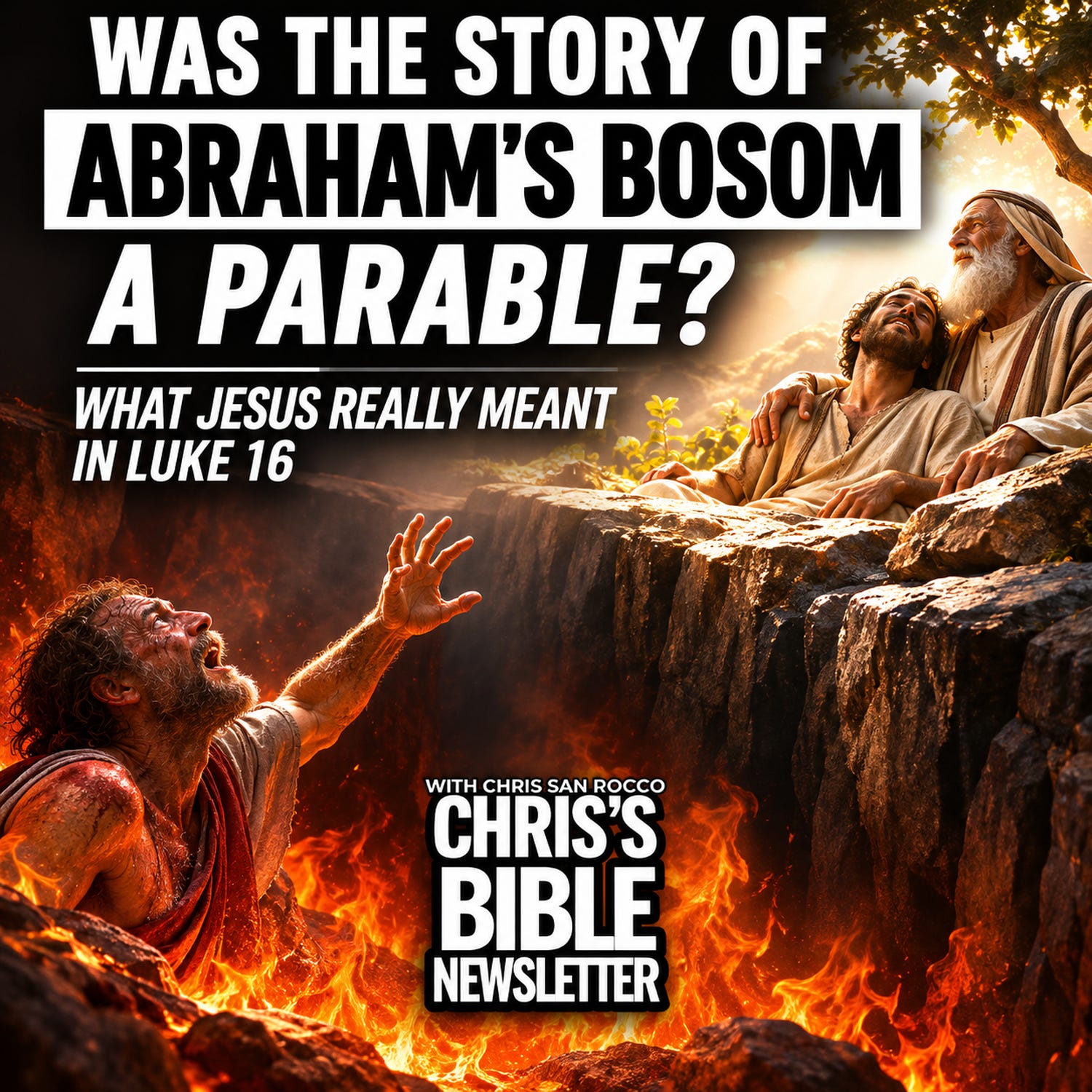
What happens here? Two men die. One is carried by angels Abraham’s side.
The other finds himself in torment in Hades. Between them lies a chasm or a huge gap, an uncrossable gap. Okay, so how do we interpret this?
For centuries, Christians, believers have debated an important question. Was Jesus describing actual events in the afterlife or was he telling a parable? Okay, so the answer it matters because some believers use this passage to construct a detailed understanding of the intermediate state, the condition of people between death and the final resurrection.
Others on the other side argue that Jesus was using familiar imagery to confront hypocrisy, the misuse of wealth, the rejection of God’s word. Both of these interpretations recognize that the seriousness of the teaching would differ on how literally we should understand the details.
So to give a responsible answer, we should go through, examine the passages within the Bible, keep it in context rather than assume that every element represents a physical feature of the unseen world.
WHAT DOES LUKE 16 ACTUALLY SAY?
The account begins with two contrasting individuals here. One is a wealthy man dressed expensive clothing who enjoys a luxurious life. Think of this as world.
Okay, this is the worldly man focused on essentially material things. No thought of eternity, which a good amount of us are, right? The other is Lazarus.
He’s a poor man covered with sores lies at a rich man’s gate longing for food. So Luke 16, 22 to 23, describes what happens next. Lazarus dies, he’s carried by the angels to Abraham’s side.
The rich man also dies and is buried. Okay, so both of them die. Both of them go down into the underworld, right?
At the time, Abraham’s bosom is the paradise and the other compartment is Hades or Sheol. Okay, then there’s another compartment underneath called Tartarus that holds fallen angels. We’re not going to talk about that much here.
So you’re going to have an understanding of the underworld. Okay, still the same today. This is still the same and you can listen to the last episode where we discussed this a little bit more detail on heaven and hell.
I will link that with the end screens for you in the description. So the rich man sees Abraham, Lazarus at a distance, and he asks for relief. Essentially Abraham responds, the rich man received good things during his earthly life while Lazarus received suffering.
Their situations have now been reversed. So Luke 16, 26, what does it say? A great chasm separates them preventing passage from one side to the other.
The rich man then asks Abraham, send Lazarus to warn his five brothers. Abraham then points him to Moses and the prophets while the rich man insists that someone returning from the dead would conceive them. Abraham responds in Luke 16, 31.
What does he say? If they do not hear Moses and the prophets, neither will be convinced if someone should rise from the dead. So the final statement, it tells us the account’s central point.
What is that? Jesus is not merely describing death, confronting people who refuse to listen to God’s revelation.
WAS JESUS TELLING A PARABLE?
The strongest reasoning for understanding Luke, we see here in Luke 16, as a parable is the setting. Jesus has already been teaching through parables. Luke 15 contains the lost sheep, lost coin, prodigal son.
It also begins with the parable of the dishonest manager. It’s Luke 16, 14. It identifies the Pharisees as lovers of money who ridicule Jesus.
He responds by exposing the difference between outward religious respectability and what God values. Luke 16, 15. The rich man and Lazarus account follows the confrontation.
Its themes, there’s wealth, reversal, judgment, and refusal to heed scripture fit naturally into Jesus’ teaching. Another important observation is that Jesus does not include or introduce the account with a statement such as this actually happened. He does not also explicitly call it a parable.
Some readers can regard it as a historical account rather than a fictional teaching. Here’s where the important distinction comes in. A parable can communicate genuine spiritual truth without every detail representing a literal historical event.
For example, the parable of the prodigal son in Luke 15, 11-32 communicates truths about repentance and forgiveness. We do not need to establish the son’s historical identity for those truths to be authoritative. Hopefully, this makes more sense.
Even if the rich man and Lazarus is a parable, its message still remains. This is important. Jesus wanted us to know this.
God wanted this in the Bible. We should pay attention to it as such. The best conclusion is that Luke 16 has strong characteristics of a parable.
Although it’s literary classification, this does remain debated. Hopefully, we can solve this more.
WHY DID JESUS GIVE LAZARUS A NAME?
An argument against the parable interpretation is that Jesus names Lazarus, so it’s not a parable. Most characters in the other parables are unnamed. We hear about a sower, a Samaritan, a father, two sons, and a wealthy landowner, but here Jesus identifies the poor man by name as Lazarus.
Does this prove he was a real person? No, not necessarily. The name is related to the Hebrew name Eliezer, meaning God has helped.
The meaning is specifically appropriate for a poor man who receives comfort from God after a lifetime of suffering. You could interpret this, believe the name may have been chosen intentionally to reinforce the account’s message. You could also argue that naming Lazarus makes the narrative specific.
It does suggest that Jesus was describing actual individuals. Neither one of these is conclusive, though. This isn’t enough.
A named character can appear in a teaching story. An unnamed character can appear in a historical narrative, just the same. Let’s move forward and distinguish this from Lazarus of Bethany, who Jesus raises from the dead in John 11.1.44 with Mary and Martha.
Interestingly, John 12.10-11 records that some religious leaders wanted to kill Lazarus of Bethany because his resurrection was leading people into Jesus. These are two different Lazarus, which is giving another example of a name. This resembles the warning at the end of Luke 16 about people remaining unconvinced if someone rises from the dead.
The connection here is not provoking, but it does not prove that Jesus was referring to the same Lazarus. The name is significant, but it does not settle whether the account is a parable or not.
WHAT EXACTLY IS ABRAHAM’S BOSOM?
This comes from imagery in Luke 16, 22-23. The Greek word refers to Lazarus being carried to Abraham’s side, essentially. In the Bible, this reclining close to someone at a meal could symbolize honor, fellowship, things like that.
John 13.23 portrays this disciple reclining close to Jesus during the Last Supper. This helps explain why being at Abraham’s side could communicate a place of honor and comfort. Some believers can interpret this as a distinct compartment of Sheol or Hades, paradise, where righteous people awaited Christ’s resurrection.
According to that view, Hades contained a place of comfort and a place of torment, like we talked about, separated by the gap. Not heaven, because we did not have access to that yet before Christ. That is where believers in God would go.
Paradise. Not heaven, but still paradise. Then that eventually moved up to heaven as it goes in Scripture.
On the other side was Sheol, or the place of torment, which we discussed in the last episode. So keep following along, but here is the distinction here. Luke 16 does not explicitly describe Abraham’s side as a separate underground compartment of Hades.
The passage says that the rich man in Hades is there, and he sees Abraham and Lazarus from far away. It doesn’t provide a detailed geographical description of where Abraham is located, nor does it explicitly state that all Old Testament believers resided in the same location. The two compartment interpretation is one way theologians have organized this imagery.
What we see here, but it is not directly spelled out in Scripture. So the central point here is what to take from this. Lazarus receives comfort while the rich man experiences anguish.
That’s the most important thing. Abraham’s side represents a literal location, figurative imagery of blessed fellowship being debated. It really doesn’t matter.
Understand what’s the message here. When you die, there is eternal paradise and there’s eternal torment. So make sure you go to eternal paradise.
It’s as simple as that.
DOES THE STORY PROVE CONSCIOUS LIFE AFTER DEATH?
It portrays both men as conscious after death. The rich man remembers his brothers. He speaks with Abraham, experiences anguish, requests assistance.
Lazarus is portrayed as receiving comfort. So this is one reason the passage is frequently cited in support of a conscious existence between death and resurrection. But other passages are also relevant here.
In Luke 23 43, Jesus promises the repentant criminal that he will be with him in paradise that day when they’re on the cross. Crucifixion in Philippians 1 23 describes Paul’s desire to depart and be with Christ. Second Corinthians 5 6 to 8 contrasts this being at home in the body with being at home in the Lord.
Revelation 6 9 to 11 depicts the souls of martyrs crying out to God, receiving white robes while awaiting vindication. So together, put all these together, the passages provide substantial support for the traditional biblical understanding of a conscious intermediate state. Again, you could go and say some believers interpret this differently.
Those who hold to conditional immortality or an unconscious intermediate state appeal to Ecclesiastes 9 5, Daniel 12 2, passages describing death as sleep such as John 11 11 14 1 verses Thelonians 4 13 16. So what does this all mean, right? The disagreement concerns how to reconcile the biblical descriptions.
Also important, the question of whether Luke 16 is a parable is separate from whether consciousness continues after death. Remember, a parable may use imagery reflecting a real spiritual reality. Okay, on the other side, interpreting Luke 16 as historical narrative does not automatically resolve every question about the intermediate state.
So let’s look at some of the biblical witnesses here as we wrap this up.
Okay,
WAS ABRAHAM’S BOSOM EMPTIED AFTER JESUS RESURRECTION?
This is another great question. Common teaching here says Abraham’s side was a temporary holding place for Old Testament believers. According to the interpretation, Jesus descended into the realm of the dead after crucifixion brought the righteous into heaven.
Several passages here do support this. Ephesians 4 8 to 10 describes Christ ascending also speaks about his descent. 1 Peter 3 18 to 20 describes Christ proclaiming spirits to spirits in prison.
Acts 2 27 31 applies Psalm 16 10 to Christ resurrection refers to his not being abandoned in Hades. But none of these passages say that Jesus emptied Abraham’s bosom. Ephesians 4 is interpreted in several ways.
Some understand Christ’s descent as his incarnation. Others connected to his death and descent to the dead. How should we take this?
1 Peter 3 is debated, particularly concerning the identity of the imprisoned spirits. Acts 2 emphasize that Christ was not abandoned to Hades and his body did not experience corruption. Philippians 1 23 and 2 Corinthians 5 8 both support the belief that Christians who die are with Christ.
Hebrews 12 22 to 24 describes the heavenly Jerusalem and the spirits of the righteous made perfect. But it does not explain a transfer from Abraham’s bosom either. Therefore, how do we take this?
The claim that Abraham’s bosom was emptied after the resurrection? This is possible with certain theological systems, but it is not explicitly taught in the Bible. We should not present this as established historical event when scripture does not describe it.
So the final verse of Luke 16.
So
HERE, THE FINAL VERSE IN LUKE 16.
The rich man asks Abraham to send Lazarus back to warn his five brothers. He believes a supernatural appearance will convince them to repent. Abraham directs attention to Moses and the prophets.
This is consistent with the larger passage. Deuteronomy 15 7 11 commands generosity toward the poor. Isaiah 58 6 to 10 it condemns religious behavior disconnected from justice and compassion.
Amos 6 1 to 7 this warns those who live in luxury while remaining indifferent to the suffering around them. In Luke 6 20 26 contrast this blessing is pronounced upon the poor with warnings to the rich and satisfied. So the rich man in Luke 16 is not condemned merely because he possesses wealth, nor is Lazarus presented as righteous merely because he’s poor.
Rather the story exposes the rich man’s indifference and the failure to respond to God’s revealed will. So if people reject scripture, even an extraordinary miracle may not produce genuine repentance. The central message that I would like you to take away of Luke 16.
It’s not technical map of the afterlife, but look at it as a warning to hear God’s word repent of accordingly before death. Okay, so to wrap this up here, some final thoughts, okay. Was Abraham’s bosom a parable?
More precisely than that. Abraham’s bosom is an image within Jesus’ account of the rich man in Lazarus. The account has strong characteristics of a parable, although believers naming Lazarus does not prove that the account is historical.
Okay, and that’s important for us to understand. Abraham’s side symbolizes comfort, fellowship, and Abraham, but its precise location is not explained. Luke 16 portrays conscious experience after death though Christians disagree about how literally to interpret this imagery.
Scripture does not explicitly say Abraham’s bosom was emptied after Christ’s resurrection. Okay, other passages support the traditional view that believers who die are with Christ. So the central warning here is simple, concerns, repentance, compassion, and listening to God’s word.
It’s important that we understand that. Move forward with that message. Subscribe if you’re getting value here.
It really does help us grow. It helps the message get out further. It takes two seconds and it’s free.
We really appreciate it. In the description, you will find links to the newsletter also free. Go ahead and put your email in.
You’ll get all of this and more sent to your email every week, which is great. There’s another community over there and some deeper study resources. I also have some other links in the description if you’d like to support.
If you’d like to join anything, explore any more resources. There’s plenty available. I will leave some end screens that you can move forward with with some more playlists.
And if you are interested, you can click into the next one.
RECOMMENDED BOOKS FOR FURTHER STUDY
As an Amazon Associate I earn from qualifying purchases.
UNLOCK PREMIUM: Get the Study Guide, My Thoughts + Q & A
Questions and Answers
1. Did Jesus actually call the rich man and Lazarus a parable?
No. Luke 16:19–31 does not explicitly introduce the account as a parable. However, it appears in a section containing other parables and shares their narrative characteristics. Its classification must therefore be determined from literary context rather than an explicit label.
2. Does naming Lazarus prove the story is true?
No. The presence of a name does not establish whether a narrative describes historical events. Lazarus is unusual because most characters in Jesus’ parables are unnamed, but a fictional teaching story can contain named individuals. The argument is suggestive, not decisive.
3. Is Abraham’s Bosom another name for heaven?
Some interpreters understand it as an image of heavenly fellowship. Others believe it describes a temporary place of comfort for the righteous dead before Christ’s resurrection. Luke 16 does not explicitly identify it with heaven or describe its precise location.
4. Was Abraham’s Bosom inside Hades?
That is a traditional interpretation, but the text does not explicitly say so. Luke 16:23 places the rich man in Hades and describes Abraham and Lazarus at a distance. The idea of two compartments within Hades is a theological reconstruction of the imagery.
5. Is Abraham’s Bosom empty today?
The Bible does not directly answer this question. Some theologians believe the righteous were transferred into heaven after Christ’s resurrection, but no passage explicitly describes Abraham’s Bosom being emptied. The believer’s hope of being with Christ is more clearly taught in Philippians 1:23.
6. Does Luke 16 prove that people are conscious after death?
It provides significant support for that interpretation because the rich man is portrayed as conscious and capable of conversation. However, those who understand the passage as a parable disagree about whether its imagery establishes the precise nature of the intermediate state.
7. Could the rich man cross the chasm after repenting?
Luke 16:26 describes the chasm as fixed and impossible to cross. The passage gives no indication of a second opportunity for repentance after death. The story emphasizes the importance of responding to God’s revelation during earthly life.
8. Why did Jesus mention Moses and the Prophets?
Because the rich man’s brothers already possessed divine revelation sufficient to warn them. The Old Testament repeatedly commands justice, mercy, and concern for the poor. Jesus’ conclusion emphasizes that hardened hearts may reject even miraculous evidence.
9. Is the Lazarus in Luke 16 the same person Jesus raised in John 11?
Scripture never identifies them as the same person. Lazarus of Bethany was the brother of Mary and Martha, while Luke 16 describes a poor man lying at a rich man’s gate. Their shared name does not establish that they are identical.
10. What should Christians believe about Abraham’s Bosom?
Christians can affirm that Jesus used the image to communicate comfort, judgment, and the seriousness of responding to God’s Word. They should be more cautious about claims concerning its exact location, physical structure, or supposed evacuation after Christ’s resurrection.
Five-Day Bible Study Plan
Day 1 — Read the Entire Account
Read Luke 16:14–31. Identify the surrounding context and Jesus’ central warning.
Day 2 — Study Jesus’ Parables
Read Luke 15:11–32 and Luke 16:1–13. Compare their literary features with the rich man and Lazarus.
Day 3 — Examine Abraham’s Bosom
Read Luke 16:19–26 and John 13:23–25. Consider how closeness and fellowship are represented.
Day 4 — Study the Intermediate State
Read Luke 23:39–43, Philippians 1:21–23, and 2 Corinthians 5:6–8. Record what each passage explicitly teaches.
Day 5 — Understand the Final Warning
Read Luke 16:27–31, Deuteronomy 15:7–11, and John 5:39–47. Reflect on how Scripture calls us to respond to God.
Closing Scripture — Luke 16:31
“If they do not hear Moses and the Prophets, neither will they be convinced if someone should rise from the dead.” (ESV)
My Thoughts
This chapter is fascinating and there are very few parts where Jesus speaks so specifically about what happens after death. It is important that when reading this chapter, we remember to look at the main points of what Jesus is saying and not get distracted by the extra details. This is a warning that we shouldn’t make this into a theory.
When considering whether this is a parable, we can often see this as a bit of a ‘false dilemma’. Just because Jesus was using a parable to teach us something, doesn’t mean that what he is trying to warn us about is not real. Jesus regularly teaches us using parables and these often contain real truths about God, salvation, judgement and our responsibility. It is the fact that Christ was teaching us that gives it authority, and not necessarily that every character can be linked to someone from history.
From reading this passage, I noticed that the rich man really cared about his brothers. He knew that they needed to make the right decisions on earth and wanted to warn them. However, Abraham told him that they had Moses and the Prophets. This shows how easy it is for us to ask for more evidence.
Whilst some theologians believe that the Bosom of Abraham was emptied after Jesus rose from the dead, I would be careful to teach this. I understand why some believe this but it is trying to link a few different bible references together. As I can’t find any verses that specifically mention this happening, I wouldn’t want to teach this as if it was a clear statement from scripture. We should be okay to be unsure about certain things!
Overall this passage reminds us how important it is to listen to God’s word. The rich man had many chances to show compassion and take the scripture seriously whilst on earth. This passage really makes us stop and think about whether our faith is just a label and whether it is actually impacting how we live our lives. This is much more important to me than knowing exactly where Abraham’s Bosom was!
Discussion about this video