
Right now, as you read this passage, something remarkable is happening. Not only are you processing the visual information, and sending signals to motor neurons to move your eyes, but you also are experiencing that thought process and physical sensation. In fact, your awareness of this reading and the thoughts and feelings that it invokes are the only things in the entire universe that you know for sure exist – and this happens to be the thing that makes the most mystery of any modern scientist.
WATCH THE VIDEO 📹
LISTEN TO THE PODCAST🎙️
The Physicalist Paradigm
For hundreds of years, the physicalist paradigm has been the dominant viewpoint in the Western world. The laws of physics and chemistry are seen as the building blocks of the universe – the ultimate reality. Everything else, from planets to people, is just matter in different forms.
Consciousness and the Hard Problem
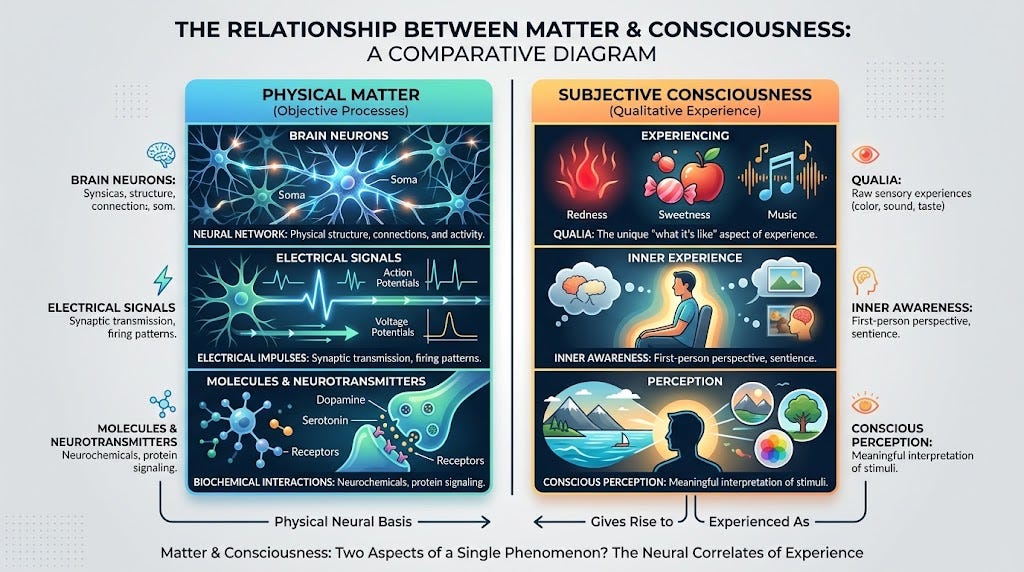
In order to understand why qualia present such a conundrum to modern physicists, it is important to separate “easy” problems of consciousness from the “hard” one.
An “easy” problem would be explaining the ways the brain influences, controls, and interprets physical sensations and thought. Although scientists have not yet discovered the processes behind higher-level reasoning, they have, through simple experimentation, been able to associate certain physical sensations with memories and triggers.
A “hard” problem, however, is explaining where these sensations, memories, and triggers originate. Why and how does a physical reaction have any qualitative aspect to it at all?
Take color, for example. Physicists may describe its wavelength, the way it interacts with the different parts of the eye, the way it is processed and recognized by the human brain – but they cannot describe what exactly red looks like, or why blue sounds like the color turquoise. An objective analysis of color would miss the very quality of being a color at all
.
Matter Cannot Explain Consciousness
Physical properties of matter have been known and measured long before consciousness was even considered as its own field of study. Length, width, mass, electrical charge, momentum – these are all qualities that have been defined by humans on a very objective basis.
Qualia, on the other hand, are incredibly subjective. You can describe the feeling of happiness in words, in triggers, in chemical reactions in the brain – but you can never describe its mass. Even in an experiment, observing a person’s thought patterns, you would notice a change in the brain, but not the thought itself. There is a huge disconnect between physical matter and human consciousness.
If physical properties were the ultimate reality, there would not be a need for a separate term, “physical.” Qualia have to be described in a different set of terms because they do not fit the same system of measurement as everything else in the universe.
The Hard Problem and the Structure of Our Universe
This disconnect between matter and consciousness is what ultimately breaks the whole physicalist paradigm. The fact that scientists cannot, even in theory, describe consciousness in terms of matter means that matter is, in fact, not the dominate force in the universe. It shifts the paradigm of physics to a completely different field – perhaps philosophy. The structure of our universe, according to physicists, would no longer be bricks and mortar, but instead consciousness and thought processes.
There are many ways to interpret this information – some say that matter is simply an extension of consciousness, while others argue that there is a “ghost” in the machine that no one has been able to describe. Either way, the fact that matter falls under a set of rules separate from qualia means that they cannot both be completely formed from the same substance.
My Statements
I believe that qualia are an undeniable part of the universe, one that should be regarded in the same regard as materialistic objects. The fact that they cannot be predicted from sheer observation of matter proves that matter itself is not the ultimate substance.
Although mental qualities can arise from physical ones, they have to be described in a different set of terms than mass or length. The way the brain works physically can be analyzed, but the sensations it creates have a very different quality to them – one that cannot be measured or predicted scientifically. I think that a physicist who chooses to ignore the fundamental nature of qualia in favor of upholding the physicalist paradigm is making a huge mistake. After all, qualia are the reason we can observe anything at all – including our own physical sensations and thoughts.


