
LISTEN TO THE PODCAST EPISODE↗
Did Chance Create Everything?
Think about what is necessary for a single stable atom to exist in the first place, not to mention creating the universe that surrounds us and allows life to be sustained. If the forces that bind the atom together were changed by a single fraction, or if the acceleration of the big bang was increased or decreased, the physical universe would have expanded at a non-sustainable rate of growth, or it would have immediately collapsed in on itself. When you begin calculating these figures out using normal probabilities, the odds of having a functional universe be created by random luck becomes so statistically improbable that it is effectively impossible. In mathematical mechanics, anything that has odds lower than a certain threshold is said to be impossible, not just unlikely.
To understand the problem from a practical standpoint, we don’t need to see the mathematics behind it all.
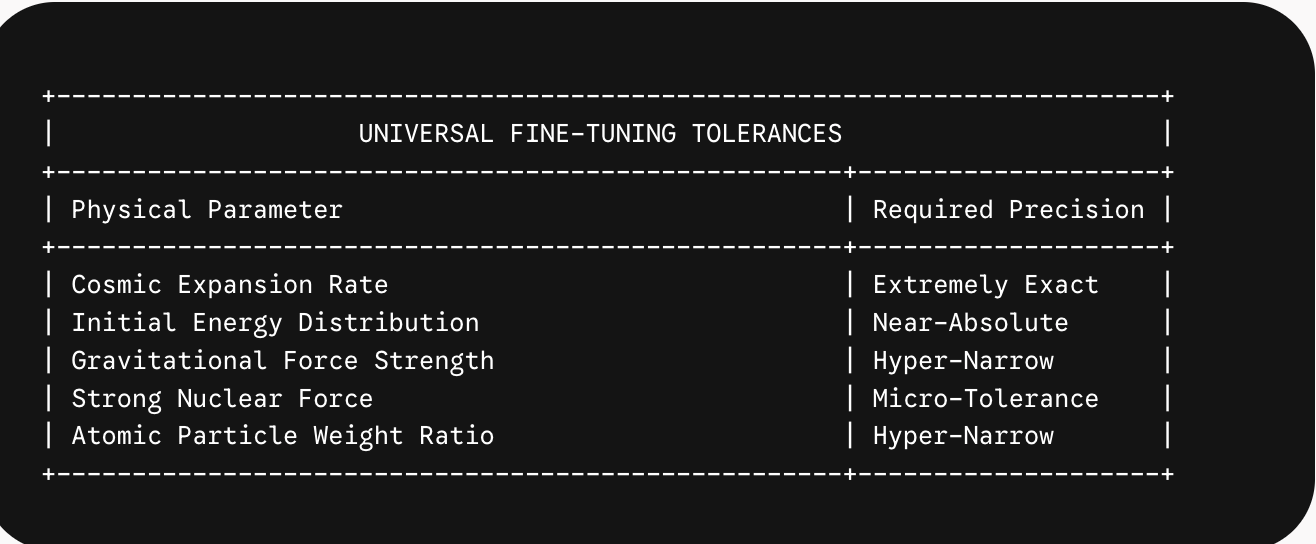
Take gravity for example; the acceleration of the big bang, the pull of gravity, the speed of light, and the ratio of each particle of matter’s weight to another all have to be within incredibly specific mathematical ranges for everything to remain sustained. If gravity was weaker or stronger by even a decimal place, our sun would not be able to ignite at all, and the universe would be nothing but black holes or non-sustainable gases
.
+-------------------------------------------------------------------------+
| UNIVERSAL FINE-TUNING TOLERANCES |
+----------------------------------------------------+--------------------+
| Physical Parameter | Required Precision |
+----------------------------------------------------+--------------------+
| Cosmic Expansion Rate | Extremely Exact |
| Initial Energy Distribution | Near-Absolute |
| Gravitational Force Strength | Hyper-Narrow |
| Strong Nuclear Force | Micro-Tolerance |
| Atomic Particle Weight Ratio | Hyper-Narrow |
+----------------------------------------------------+--------------------+
The conditions at the time of the big bang had to be even more specific, as a very ordered energy had to be distributed for there to be structure for the universe to take shape in.
The calculations performed on these initial conditions have shown that the conditions needed to reach an exact average, an absolute precision with no room for error that required more factors to be in order than there are particles in the entire universe. Chance operates within the rules of statistics, and when you demand a level of precision that is exponentially higher than the physical limits of the universe, saying that a certain level of order was reached through mere chance is intellectually dishonest
.
Scripture speaks quite a bit about the material universe and its relationship to the creator.
In Psalm 19:1, it says “The heavens declare the glory of God; the skies proclaim the work of his hands.” The physical universe is presented as a source of empirical information that can be used to understand the nature of God as an entity.
Colossians 1:17 says “He is before all things, and in him all things hold together,” which is extremely reminiscent of the conservation laws that physics has established, the exact forces responsible for allowing the universe to function as it does.
In Isaiah 45:18, it says “For this is what he said: ‘Long ago I decreed it; in days long past I planned it; I made the earth, and what comes out of it, and fashioned the world and what fills it.’‘’ - The design that the creator put into the physical universe is directly implied here, as not only did the creator make the physical materials for the universe to exist, but it planned out the exact conditions necessary prior to the formation of the universe being initiated.
The fundamental physical laws of causality dictate that for anything to happen, there must be a sufficient cause for it to happen.
Chance has no physical presence; it is simply a label we apply to events that have mathematical properties we can quantify. Saying that something happened due to chance has no different effect on the physical world as claiming that it happened due to divine intervention - they are both entirely unsubstantiated claims that ignore the tangible mechanics of the world. The sheer complexity, order, and precise physical properties of the material universe demand a source of causality that has equal complexity to it - it cannot come from something that has no complexity at all, such as a force or entity that has no definable presence in the first place.
I view these facts as an unassailable truth from an unbiased standpoint.
The sheer physical precision that the universe has been established to have is statistically impossible to attribute to mere chance. I find that the simplest conclusion is that the universe’s order is the result of some external intelligence directing it to be so.
I don’t view my agreement with these claims to be anything other than a natural consequence of observing the universe objectively. The physical properties of the universe adhere to strict laws and tangible values in a way that strongly implies an engineered source. Once you get to a point where the odds of something occuring are no longer possible, the natural conclusion is that it cannot happen - and yet it has, therefore something else must be responsible for it happening.


