
WATCH THE VIDEO 📹
LISTEN TO THE PODCAST🎙️
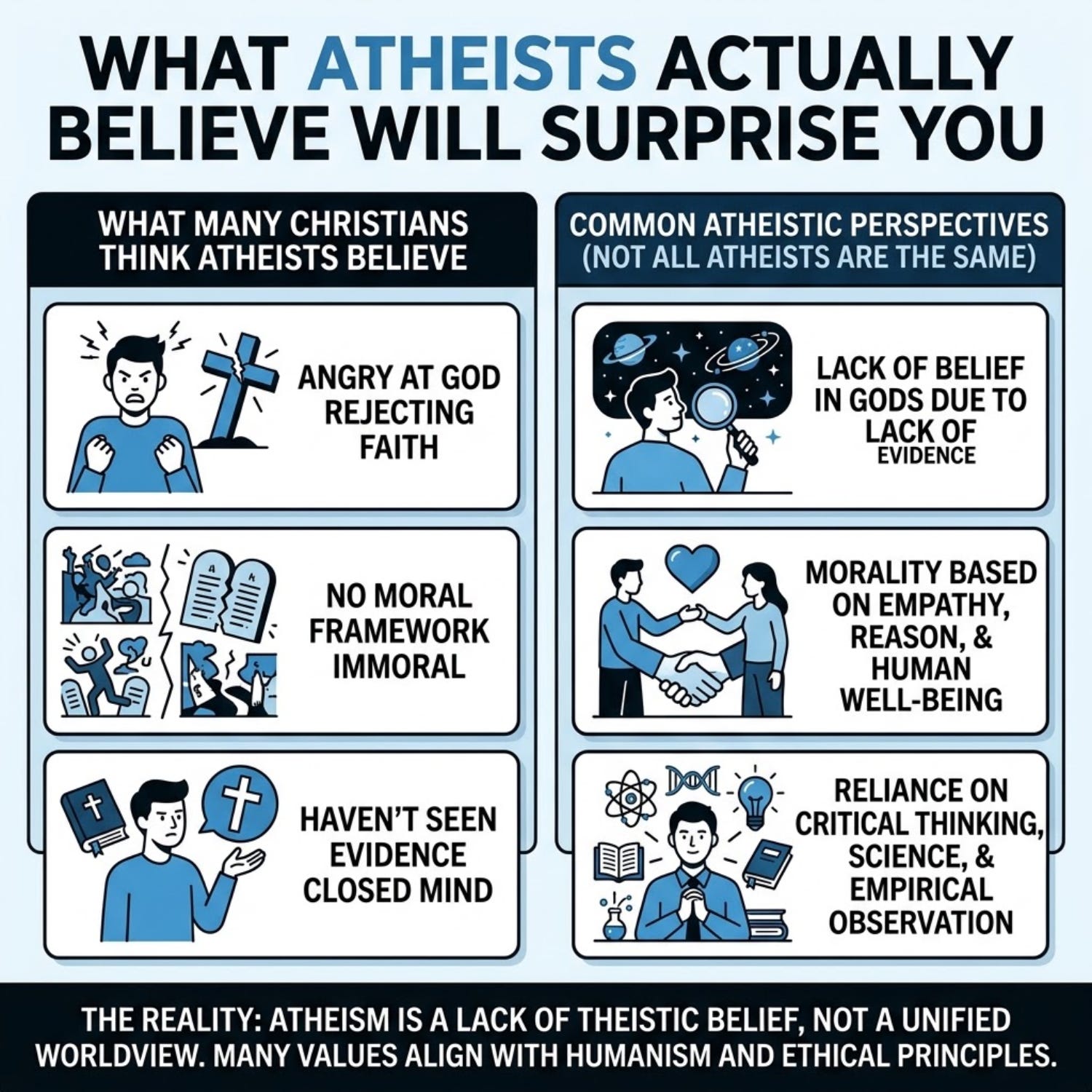
Most Christians believe they understand what atheists believe. To them, it’s that atheists are angry towards God or that they are immoral, or that they need better evidence for God’s existence. However, when actually engaging with an atheist, one will quickly learn that atheism is not a monolithic ideology, but many differing worldviews and beliefs without a clear directive. In order to engage with atheists, one must have at least an elementary grasp of these varying beliefs.
What You Will Learn
The exact definition of atheism and why it is misunderstood
The difference between “weak” and “strong” atheism
What atheists actually say about the world, not just what they say against
The importance of science, reason, and evidence to atheistic thinking
How atheists view morality without God
Why this is important to your faith and witness
Defining Atheism: More than “No God”
The word atheism comes from the greek a(without) and theos(god). Atheism, in it’s most basic form, is the lack of belief in any deity. However, there are two main types of atheists. There are those that believe there is no god and those who simply don’t believe in a god because they don’t have enough justifying evidence. The former is “strong atheism” or “positive atheism”. The latter is “weak atheism” or “negative atheism”.
Strong atheists make the claim “there is no God” and believe they have enough evidence or reason to believe their assertion. Weak atheists make no such claim. They simply state that they do not believe in a god due to the lack of sufficient evidence. It is important to note the difference between weak and strong atheism as the former is much easier to refute. You want to engage a strong athiest as they generally can carry on a rational conversation without their emotions clouding judgement. A weak atheist is much like someone that hasn’t been convinced and that holds a very different type of conversation. Weak athiests will generally make 1 or 2 points then get some push back from you and shut down or start to argue without making further points. The important thing to understand is you do not have to continue into a debate if both sides are not giving some level of respect. When 1 party stops being respectful the other may do the same or shut down and this is the fastest way to get nowhere in a debate. Atheiests are looking for a resason to shut you down so don’t give the one.
The Spectrum of Atheism
As previously mentioned there are atheists that are former Christians, former Muslims, or those that were raised without any religion. There are atheists that are very philosophical and those that are very practical. There are atheists that are very hostile towards religion and those that are completely indifferent. You can see how this can be a very wide spectrum and you want to make sure you have a general idea on each of these positions.
There is a difference between explicit and implicit atheism. Explicit atheism is when an atheist has consciously rejected belief in a deity. Implicit atheism is when an atheist has never really considered the idea. You will find the highest number of implicit athiests generally in the secular realm. They don’t really think about it much but live and act as if God does not exist.
There is also a difference between intellectual and emotional atheism. Intellectual atheists are those that came to atheism through reason. Emotional atheists are those that came to atheism through anger (they may have experienced abuse by religious authority figures), suffering (they may have had a hard time with the problem of evil), or from betrayal (they may have felt that being Christian was a betrayal of their morals). It is important to understand these differences as you may not be able to effectively communicate with one type of atheist, but not another
What Atheists Reject
At the core of atheism is the rejection of theistic claims but atheists also reject several other concepts. Explicitly, atheists will reject the concept of a god or any higher power but most reject the entire theistic worldview. They believe the world is a closed system. There is no afterlife, no soul, and no higher power controlling things. They also reject the concept of an objective morality as they believe morality is a human quality, not a divine one.
This does not mean that atheists are immoral or that they believe murder is okay. Many atheists are very moral individuals. They may believe that it is wrong to murder because it hurts people and has a negative effect on society as a whole. However, if there is no God, then morality is subjective and everyone has their own definition and set of rules
.
What Atheists Affirm
It is wrong to assume that atheism is purely a negative position. Many atheists take very strong, positive stances on several matters. It is generally agreed upon that the universe is all there is. They are physical beings with physical bodies and physical thoughts. They are mortal and that nothing exists after death. They believe that morality is subjective, based on opinions.
It is important to realize that these are all natural consequences of atheism. If there is no God or higher power then there is nothing greater than humans. We are the cream of the crop. We are the top of the food chain.
This has led to what is known as the “meaning crisis” among atheists. The philosopher Friedrich Nietzsche (who wasn’t an atheist, but predicted the eventual “death of God”) believed that once God died, there would be a crisis of meaning. The same crisis can be seen today in the modern atheist. He does not believe that there is any objective meaning to life, but he creates his own subjective meaning.
Why This Matters for Christians
Understanding atheism can help you to engage atheists more effectively. You can hold meaningful conversations with them and perhaps share the Gospel. The Bible tells us to love our neighbors, even those that are mean to us 1 Peter 3:15 “But in your hearts revere Christ as Lord. Always be prepared to give an answer to everyone who asks you to give the reason for the hope that you have. But do this with gentleness and respect.” We are to engage atheists with gentleness and respect and not to anger them, but rather to make them curious about why we hold the views that we do.
What You Learned
Atheism is defined as the absence of belief in God, but it includes both strong atheism (asserting no God exists) and weak atheism (simply lacking belief).
Atheists hold positive beliefs about the universe, humanity, and morality, not just negative rejections of theism.
Atheists often rely on science and reason as their primary means of knowing truth, viewing naturalism as sufficient to explain reality.
Many atheists affirm a subjective, human-centered morality, while Christians believe morality is grounded in God’s character.
Understanding atheism helps Christians engage with atheists more effectively, with gentleness and respect, as commanded in 1 Peter 3:15.
Resources
Richard Dawkins, The God Delusion
C.S. Lewis, Mere Christianity
Stephen Hawking, The Grand Design
Friedrich Nietzsche, The Gay Science


