
In the early 2000s, several prominent atheists rose to prominence and dedicated themselves to the task of ridiculing and debunking God and his teachings. Richard Dawkins, Christopher Hitchens, Sam Harris, and Daniel Dennett, as the leaders of the so-called “New Atheism,” wrote articles and books, gave interviews and public speeches, and even engaged in open on-air debates with representatives of the Christian faith. An understanding of the views of these philosophers is crucial to combating them effectively.
What You Will Learn
The central figures of the New Atheism and the essence of their views;
The arguments these atheists use to oppose Christianity;
What distinguishes New Atheism from other atheistic movements;
Why Christians should care what these people say;
Rebuttals to the arguments presented by New Atheism leaders.
The Main Figures and Their Books
The English biologist Richard Dawkins was the first famous representative of the New Atheism. In 2006, he published the book The God Delusion , which made him a household name and one of the most prominent critics of religious faith. Dawkins’ book, as well as the works of his contemporaries, was intended to popularize atheism and undermine the foundations of religious faith.
Christopher Hitchens, a renowned journalist and essayist, published God Is Not Great in 2007. Compared to Dawkins, Hitchens was a more dynamic and aggressive opponent of religion. In his book, he argued that religion corrupted everything and made people unreasonable. Other critics of religious faith, namely Sam Harris and Daniel Dennett, expressed similar views. However, Dawkins and Hitchens were the most prominent among the New Atheism leaders.
It is noteworthy that New Atheism does not differ significantly from previous atheistic movements. Over a century ago, atheists held meetings, wrote articles, and gave speeches on the supposed nonexistence of God. The difference between the New Atheism and its predecessors lies in the public and aggressive opposition of Christians, which New Atheists embodied through their works of popular science and criticism of Christian principles.
The Core Arguments
New Atheism leaders traditionally adhere to several arguments against the Christian religion. Firstly, Dawkins and his contemporaries argue that belief in God is unreasonable and unsupported by evidence. Dawkins writes that there is no more reason to believe in Zeus or any other pagan deity than in the Christian God. Secondly, New Atheism opponents of Christianity argue that religion brings only suffering and violence.
Hitchens, in particular, actively argues that religion corrupts and makes people savage. Thirdly, Dawkins and Hitchens write that the emergence of natural sciences such as biology and physics diminishes the need to believe in God. With the development of evolutionary biology and genetics, believers lose one of the main reasons for believing in God, namely the inexplicability of the origin of life. This argument is based on the so-called scientism, which is the position that only scientific knowledge can be considered true.
Moreover, Dawkins and Hitchens write that the existence of God is unreasonable from a logical point of view. The New Atheism opponents of Christianity argue that theologians cannot answer simple questions about God and that the Bible’s teaching contradicts common sense
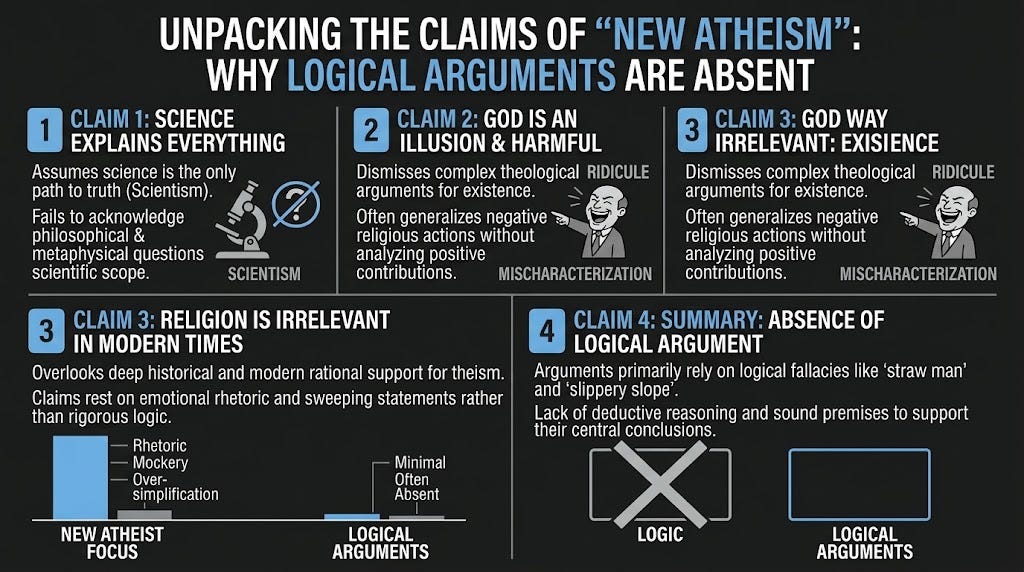
Where the Logic Breaks Down
The main argument against the New Atheism lies in the very definition of this term. New Atheism is inherently opposed to Christian faith, but there is no doubt that this doctrine is built on controversial foundations. Many philosophers, both Christian and atheist, have criticized Dawkins for being too confident in his position when it comes to Christian theology. While Dawkins and Hitchens argue that religion corrupts and makes people unreasonable, many Christians would agree that it is, indeed, atheists who are unreasonable in their opposition to Christian principles.
The assumption of scientism as the basis for criticizing religious faith does not hold water either. Declaring physics and biology as the only truth will not make theology any less valuable. Science answers fundamental questions about the workings of the universe, but it cannot say whether human life has meaning and purpose. The Bible answers these questions, while Dawkins and Hitchens insist that such answers do not exist.
According to the Bible, “the wrath of God is revealed from heaven against all ungodliness and unrighteousness of men, who suppress the truth in unrighteousness” (Romans 1:18). New Atheism opponents of Christianity argue that belief in God is irrational. However, they ignore the fact that the unreasonableness of faith in God is precisely one of the reasons for the fall of humanity. From a Christian point of view, it is not atheists who are unreasonable, but those who blindly believe in the power of reason.
What You Learned
In the early 2000s, a new wave of critics of Christianity arose.
New Atheism leaders Hitchens, Dawkins, Harris, and Dennett opposed religious faith and sought to debunk Christianity.
The essence of their argument lies in the irrationality of belief in God and the harmfulness of religion in general.
New Atheism proponents argue that the emergence of natural sciences deprived humanity of the need to turn to God.
New Atheism rests on the position of scientism and several other controversial arguments.
My Thoughts
New Atheism drew attention to itself as a phenomenon that questioned the rationality of religious faith. However, it would be a mistake to perceive it as something more than an interesting atheist movement. New Atheism opponents of Christianity are unreasonable in their position, arguing that belief in God is irrational. Moreover, they are wrong to say that natural sciences provide answers that were previously given by religion. A more careful examination of their positions reveals several inconsistencies that undermine the foundations of New Atheism.
It is also worth mentioning that at the moment New Atheism is in decline. Although Dawkins and Hitchens were once popular public figures, they are now gradually forgotten. Young people increasingly prefer a more humane and tolerant Islam, and New Atheism, as a whole, is gradually dying out as well.


