

Hell (Hades/Sheol) is often seen as a temporary holding place for the dead (souls/spirits) awaiting final judgment, while the Lake of Fire (also called Gehenna) is the permanent, final destination of eternal destruction, where even Hell and Death are cast in, representing the ultimate, irreversible punishment after the Final Judgment. Think of Hell as the waiting room and the Lake of Fire as the final, eternal prison for the unrepentant, Satan, demons, and the truly wicked.
This episode will explore how this act represents not merely punishment but the complete end of death’s reign, the dismantling of the spiritual realm of the dead, and the final and irreversible destiny of the unsaved.
Revelation 20:14
Revelation 20:14 is one of the most theologically dense and mysterious verses in all of Scripture. In a single sentence, God reveals the final fate of death, the temporary realm of the dead, and the ultimate judgment of the wicked:
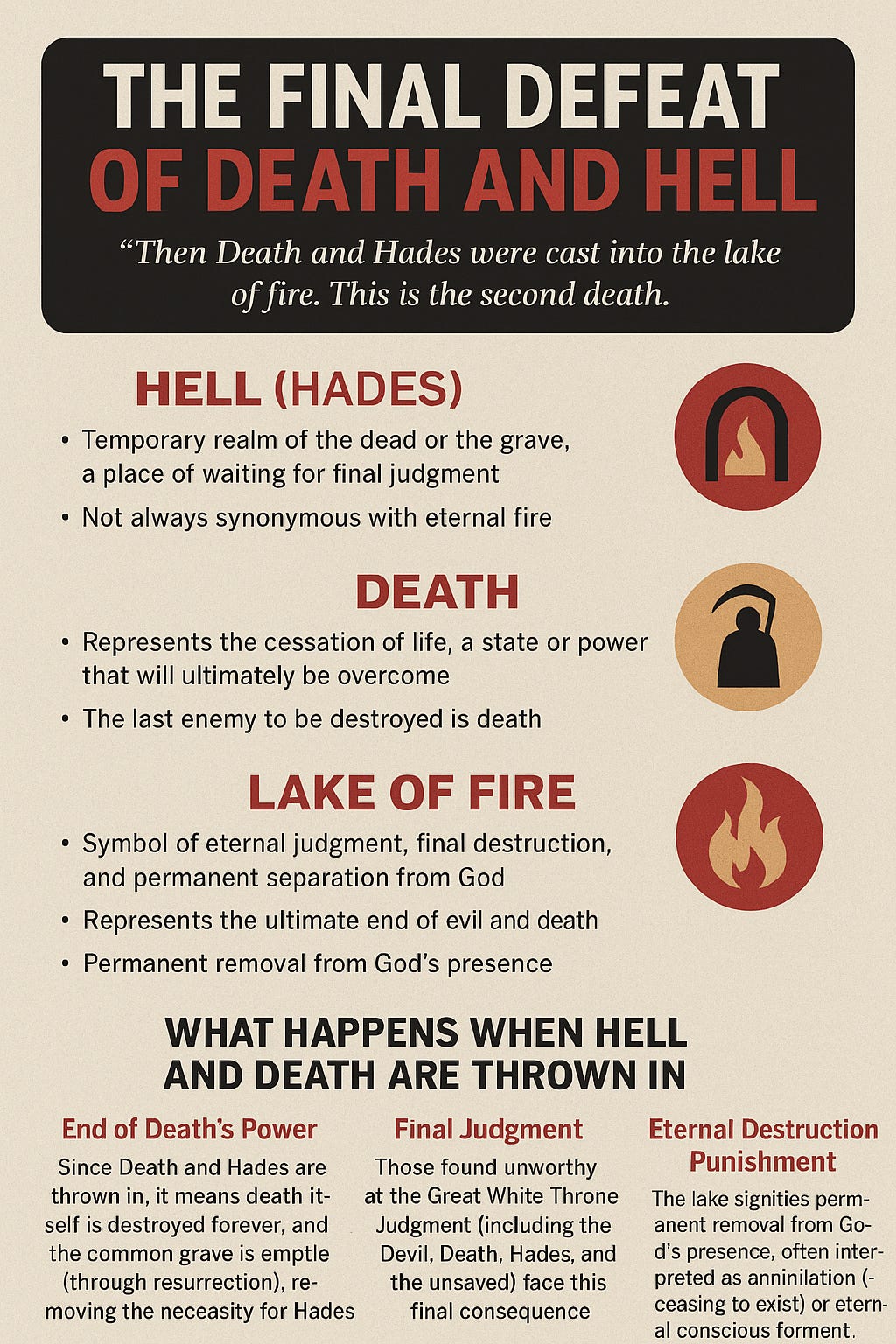
“Then Death and Hades were cast into the lake of fire. This is the second death.” — Revelation 20:14
This verse is more than a statement of judgment—it is the climax of God’s victory over sin, death, and every power of darkness. To understand it, we must unpack the biblical meaning of Hades, Death, the Lake of Fire, and the Second Death, and see how they converge in this prophetic moment.
1. What Is “Hell” in Revelation 20?
Many English Bibles translate “Hades” as “hell,” but this creates confusion. The Bible speaks of “hell” in more than one way.
1. Hades/Sheol = The Temporary Realm of the Dead
In the Old Testament, Sheol is the grave, the unseen realm, the place where all the dead go. It is not described as fire, torment, or final judgment. It is simply “the realm of the dead.”
In the New Testament, the Greek word Hades carries this same meaning. It is a temporary holding place for souls awaiting resurrection and final judgment.
Key idea:
Hades is not the final hell. It is the intermediate state.
2. Gehenna = The Final Place of Judgment
Jesus often used the word Gehenna, not Hades, to describe final divine judgment (e.g., Matthew 5:22, 29–30). Gehenna is far closer to what we call the “lake of fire.”
Therefore:
When Revelation says Hades is thrown into the lake of fire, it means the temporary realm of the dead is abolished.
Hades is not eternal.
The Lake of Fire is.
2. Understanding “Death” as a Spiritual Power
Death in Scripture is not merely biological. It is described as a power, a curse, and even an enemy:
“The last enemy to be destroyed is death.” — 1 Corinthians 15:26
Death entered through sin (Romans 5:12).
Death enslaved humanity (Hebrews 2:14–15).
Death held dominion until Christ shattered its chains.
But even though Christ conquered death at the resurrection, death still exists in the world today—until Revelation 20.
When John sees Death being thrown into the lake of fire, it signifies:
The end of the curse
The end of mortality
The end of any possibility of dying ever again
The final victory of God over the last enemy
This moment is the fulfillment of all promises that death will be no more (Revelation 21:4).
3. The Lake of Fire: Symbol of Final Judgment
The Lake of Fire in Revelation is the final destination for:
The devil (Revelation 20:10)
The beast and false prophet (Revelation 19:20)
Death
Hades
All whose names are not written in the Book of Life (Revelation 20:15)
What does the lake represent?
A. Permanent Separation From God
Unlike Hades (temporary), the Lake of Fire is:
Final
Irreversible
Eternal
This is why it is called the Second Death.
B. The End of All Evil
No more rebellion.
No more sin.
No more spiritual death.
No more grave.
God does not rehabilitate evil. He eradicates it.
C. The Final Expression of God’s Justice
Every wrong, every act of rebellion, every unrepentant heart meets its final accounting here.
4. What Does It Mean for “Hell” and “Death” to Be Thrown In?
1. The Destruction of Death’s Power
When Death is cast into the fire, it means:
Death can never claim another life.
No being will ever die again.
Resurrection is complete and final.
Eternal life is unthreatened forever.
This is why Revelation 21:4 says:
“There shall be no more death.”
2. The End of Hades (the Realm of the Dead)
Hades has no purpose once:
The dead are resurrected
Judgment is complete
Eternity begins
Hades is essentially emptied, judged, and then eliminated.
3. The Final Judgment of the Unsaved
Once Death and Hades are judged, those who followed the path of rebellion face the same destiny:
“This is the second death.”
The “second death” is the eternal and irreversible consequence of rejecting God’s gift of life.
5. Eternal Torment or Annihilation?
Eternal Conscious Torment
The lake fire is described as “torment day and night forever and ever” for the devil (Revelation 20:10).
Jesus says punishment is as eternal as life (Matthew 25:46).
The smoke of torment rises forever (Revelation 14:11).
We can clearly see that whether in Hell or the Lake of Fire the Punishment will be on going. If someone goes to Hell they will be tormented and punished until Christ throws Hell into the Lake of Fire and the punishment continues for eternity.
6. The Second Death: The Ultimate Reality
The second death is the opposite of eternal life.
It is the final state of all who reject Christ’s salvation.
The First Death:
Biological death, which all experience (Hebrews 9:27)
The Second Death:
Permanent spiritual death—eternal separation from God.
Those in Christ are resurrected into eternal life.
Those apart from Christ are resurrected into final judgment.
There is no third category.
7. Why Does God Destroy Death and Hades?
Because God’s plan is not simply to judge evil—it is to undo everything evil accomplished.
Jesus did not come just to forgive sins.
He came to reverse the curse, crush death, and restore creation.
Casting Death and Hades into the Lake of Fire means:
No more funerals
No more cemeteries
No more suffering
No more fear
No more separation
No more sin’s consequences
No more temporary realms of the dead
Eternal life is secure forever
This is the completion of redemption’s story.
8. The Victory of Christ in Revelation 20
By the end of Revelation 20:
Satan is defeated
Evil is judged
The dead are resurrected
Justice is executed
Death is destroyed
Hades is abolished
The wicked face final judgment
God’s eternal kingdom is unveiled
This is the triumph Christ promised in Revelation 1:18:
“I have the keys of Death and Hades.”
When Christ throws these into the fire, He demonstrates total supremacy over every enemy.
Final Summary
Hades is a temporary realm, not the final hell.
Death is a spiritual power that will be completely abolished.
The Lake of Fire is the final, eternal judgment for Satan, Death, Hades, and the unsaved. (Final eternity for unbelievers)
The second death is the irreversible destiny of those who reject God.
Revelation 20:14 marks the end of death’s reign, the end of the grave, and the full victory of Christ.
Death and Hades are destroyed “there shall be no more death.” (Revelation 21:4)


