
Most people act as though truth is invariable until it isn’t. We all agree that 2+2=4, but when asked whether biological sex is real or whether justice should be the same for everyone, suddenly people claim that truth is whatever you decide it to be.
What You Will Learn
Why objective truth exists independently of anyone’s beliefs
How relativism undermines itself
How objective facts differ from subjective preferences
Why abandoning objective truth damages society and discussion
What the Bible has to say about objective truth
How to spot when someone is using relativism as an argument
Objective Truth Exists Independent of Belief
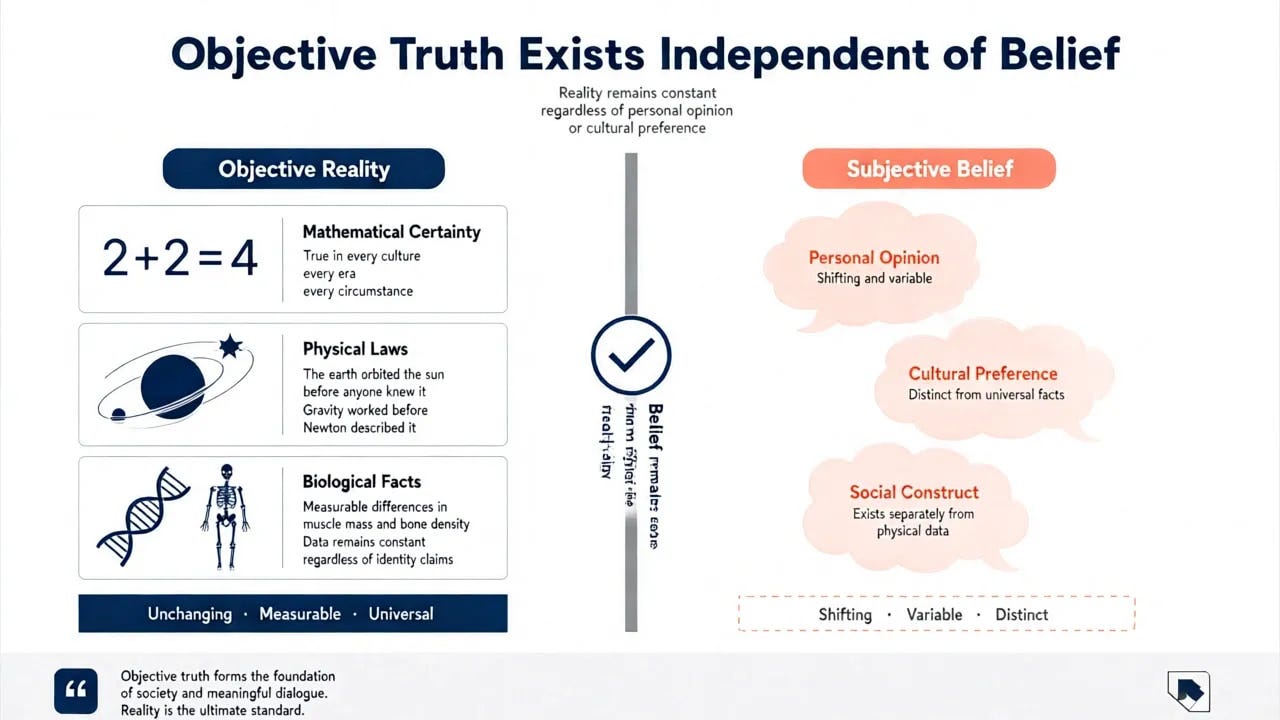
Objective truth is what’s true regardless of whether anyone believes it. The earth orbited the sun long before we realized it. Gravity worked long before Newton described it. The math doesn’t change just because someone disagrees with it. 2+2=4 in every culture, in every era, in every circumstance. This is objective truth.
Biology works the same way. Male and female bodies have objective physical differences, such as muscle mass, bone density, and overall skeletal structure. These facts remain true regardless of anyone’s identity. When we disregard objective physical reality to accommodate other preferences, we are not being compassionate--we’re being objectively wrong.
Jesus said in John 14:6, “I am the way and the truth and the life.” He didn’t say, “I am a truth and your truth.” He claimed to be the objective truth.
Relativism Contradicts Itself and Falls Apart
The problem with moral relativism is that the statement, “all truth is relative,” claims to be an objectively true statement. If it’s simply relatively true, then it can’t bind anyone, because it’s not objectively true. If it’s objectively true that all truth is relative, then the speaker is contradicting himself.
The same problem comes up when people claim that your truth and my truth are equally valid, even when they contradict each other. This position undermines any hope of discussion or debate, because if your truth and my truth are both binding, then we have nowhere to go. A judge could not deliver a sentence because your crime would be relative to your truth. A doctor could not declare a diagnosis because your illness would be relative to your truth. A parent could not discipline a child on the idea that right and wrong were relative to the child’s truth. Society cannot function without universally accepted objective moral standards, or else everyone is serving their own “truth” with no ability to appeal to anything bigger.
Proverbs 14:12 says, “There is a way that seems right to a man, but in the end it leads to death.” This is only true if there are standards to measure against--what seems right versus what actually is right, subjective versus objective.
Subjective Preferences Are Real But Not Universal Truths
This is where people get confused. There’s nothing wrong with subjectively preferring coffee to tea. I do it all the time, and it’s no skin off my nose if you prefer tea to coffee. However, the fact that I prefer coffee to tea isn’t actually a universal truth.
Same goes with morality. When we say that slavery is wrong, we’re making a claim that not only is it undesirable, but that it objectively ought not to be, because it violates an objective moral standard that all people can recognize. If slavery was simply a matter of subjective preference, we couldn’t condemn it in other cultures or time periods, and most obviously in our own if it turns out to be desirable to us. But most people know intuitively that slavery is objectively wrong, not only for us, but for everyone.
The Bible actually grounds morality in the nature of God Himself, rather than in some cultural preference. God didn’t create morality and then decide what to do based on it--God’s nature itself is the standard by which we judge morality. Exodus 34:6 is God describing Himself as “merciful and gracious, slow to anger, abounding in love and faithfulness...
Why Abandoning Objective Truth Breaks Everything
When a society collectively abandons objective truth, you end up with a society that can no longer function. You can’t have bridges built on subjective engineering, or crime punished under subjective law, or medicine practiced under the auspices of disease being subjective.
Furthermore, relativism serves as a tool for the strong to dominate the weak. There’s no appeal to anything bigger than your particular tribe and its preferences. History is rife with examples of this type of tribal fighting, with no ability to appeal to any truth bigger than yourself--and in practice this always leads to domination by the more expansionistic tribes at the expense of the smaller, weaker ones.
What You Learned
Objective truth exists independent of belief, such as in math and physics
Relativism contradicts itself and makes discussion impossible
Subjective preferences are real but are not actually universal truths
A society that abandons objective standards for morality and reality can no longer function
The Bible grounds morality in the objective nature of God
My Thoughts
The push for relativism is really a desire for dominion. If truth is what you decide it to be, then you can decide who gets to speak and who doesn’t--which is why relativism is always advanced by those who seek to dominate others under the guise of tolerance.
The Christian view of truth being grounded in the objective nature of God is actually a freeing one, because it means that we don’t have to create morality and constantly defend it. We can appeal to an objective source for our morality, our rights, and our ability to discuss truth generally.
Common Questions
Q: Isn’t believing in objective truth being intolerant? No. You can believe that something is objectively true and still be tolerant of those who believe otherwise. In fact, you can’t have tolerance without objective truth, because tolerance only exists when you realize that something is wrong. If there’s no objective truth, everything is a matter of opinion and there are no grounds for discussion--except to appeal to someone having a “superior” opinion.
Q: Don’t scientists constantly change their minds? They may revise certain details, but they’re all converging on an objective view of the world. The reason scientists change certain beliefs is because they found out that a previously-held view was objectively wrong. This is how we know there’s an objective view of the world--because we can be wrong about it. Jesus said in John 8:32, “You will know the truth, and the truth will set you free.”
Q: How do you know that your interpretation of the Bible is the objectively correct one? I don’t think that anyone’s claiming that their interpretation of the Bible is objectively correct. What we do know is that the Bible itself contains objectively true statements. Either Jesus rose from the dead or He didn’t, and either God exists or He doesn’t. We can interpret those facts however we want, but they’re objectively true.
Q: Isn’t this denying people’s experiences? No. It recognizes that experience is subjective. You may feel that something subjective is true, but that doesn’t make it so. Objective truth actually helps protect subjective truth, by making sure that justice and rights are upheld no matter what your subjective experience is.


