
WATCH: All episodes available on YouTube
LISTEN: Apple, Spotify, Youtube Music
The Importance of the Question
Whether Adam and Eve were historical individuals matters deeply to Christian faith. The doctrine of sin, salvation, and Christ’s role as Redeemer rests on whether there truly was a first man and woman through whom sin entered the world. Let’s compare Scripture to see how the Bible treats Adam and Eve—not as myth, but as real people.
Ten Key Scriptures Compared
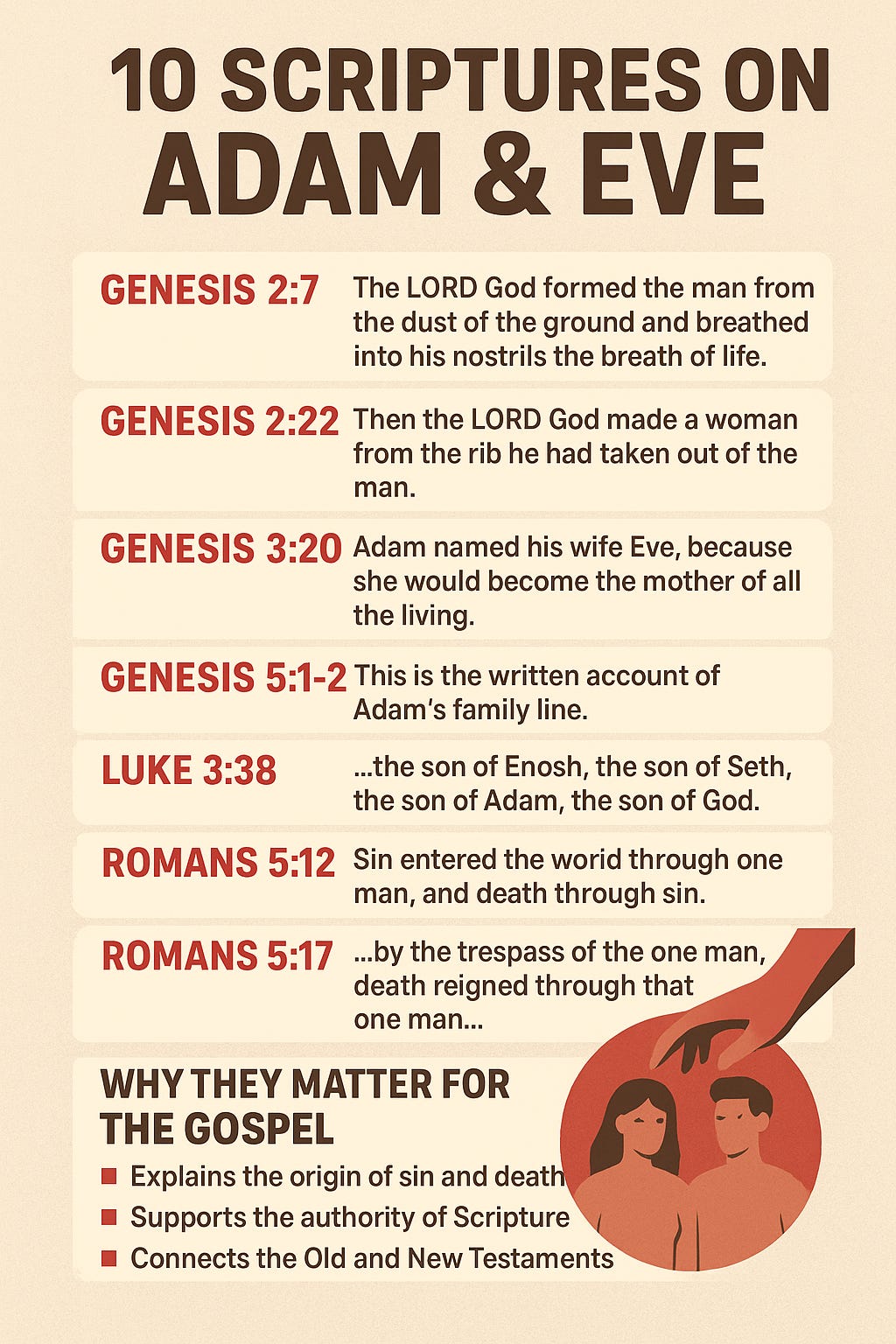
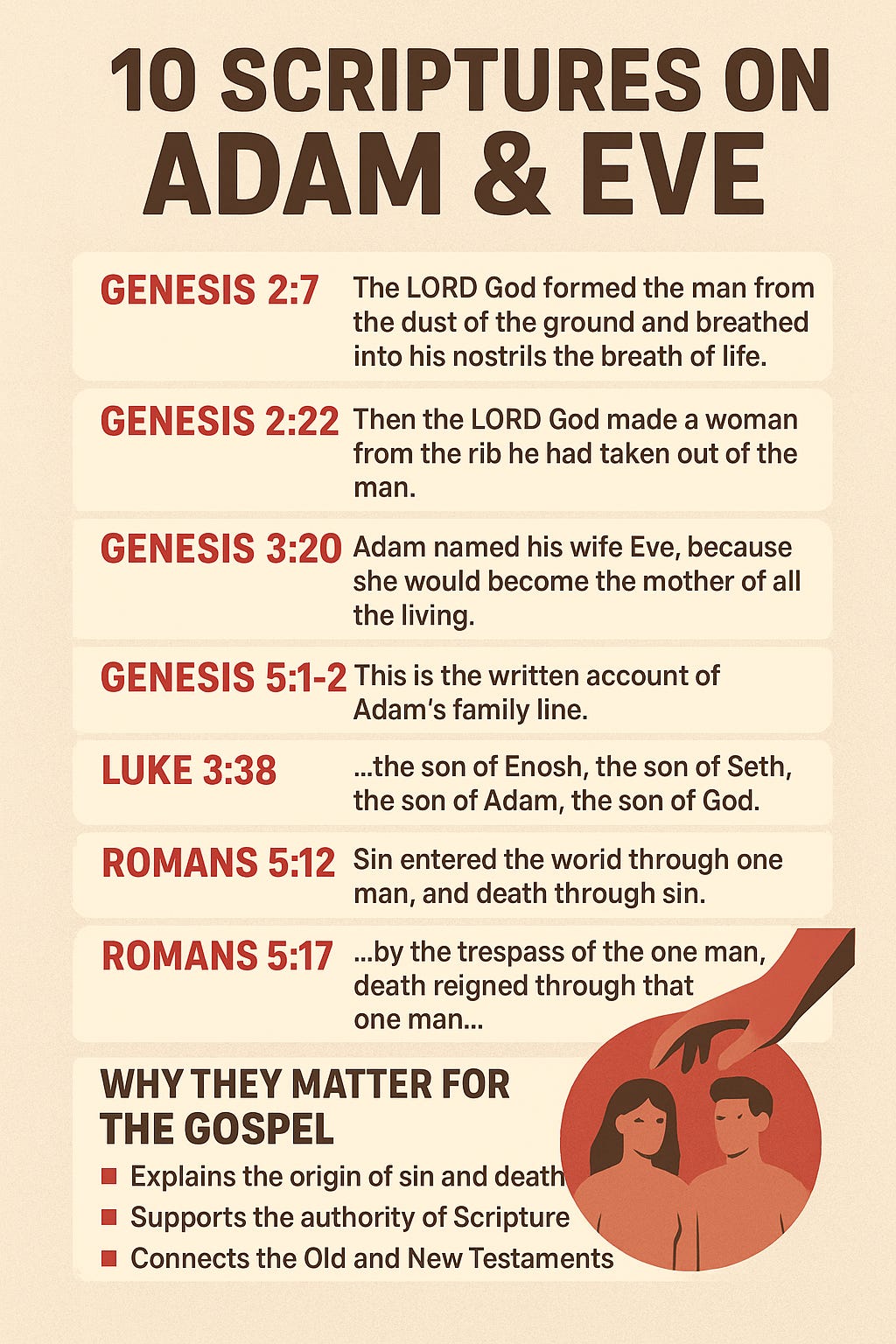
Genesis 2:7 — “The LORD God formed the man from the dust of the ground and breathed into his nostrils the breath of life.”
Direct description of Adam’s creation.
Genesis 2:22 — “Then the LORD God made a woman from the rib he had taken out of the man.”
Historical detail about Eve’s origin.
Genesis 3:20 — “Adam named his wife Eve, because she would become the mother of all the living.”
Eve’s role is tied to human lineage.
Genesis 5:1–2 — “This is the written account of Adam’s family line.”
Genealogical record, not allegory.
Luke 3:38 — “…the son of Enosh, the son of Seth, the son of Adam, the son of God.”
Adam included in Christ’s genealogy.
Romans 5:12 — “Sin entered the world through one man, and death through sin.”
Adam as a real cause of humanity’s brokenness.
Romans 5:17 — “…by the trespass of the one man, death reigned through that one man…”
Paul’s theology depends on Adam’s real existence.
1 Corinthians 15:22 — “For as in Adam all die, so in Christ all will be made alive.”
Parallel between historical Adam and historical Christ.
1 Corinthians 15:45 — “The first man Adam became a living being; the last Adam, a life-giving spirit.”
Adam is contrasted with Jesus in a literal sense.
Matthew 19:4–5 — “At the beginning the Creator ‘made them male and female.’”
Jesus affirms Genesis creation as historical.
Top 5 Questions and Answers
1. Were Adam and Eve literal or symbolic?
Scripture presents them as historical people. Genealogies and Paul’s theology only work if Adam and Eve were real.
2. Why does their existence matter for the gospel?
Without Adam’s fall, there is no reason for Christ’s redemption. Romans 5 connects the two directly.
3. Could Adam and Eve be “representatives” of humanity rather than individuals?
The Bible calls Adam “the first man” (1 Cor. 15:45), not a symbol. His choices had real consequences.
4. Didn’t science prove Adam and Eve couldn’t exist?
Science explores material evidence, but Scripture deals with divine revelation. The Bible affirms Adam and Eve as the first humans under God’s design.
5. How does Jesus’ view settle the issue?
Jesus Himself quoted Genesis as historical fact (Matt. 19:4–5). As Christians, His testimony carries the highest authority.
Action Steps
Read Genesis 1–3 slowly and note every detail that points to historical events.
Compare Romans 5 and 1 Corinthians 15 with Genesis 3 to see how sin and redemption connect.
Affirm the authority of Jesus’ words by meditating on Matthew 19:4–5.
Pray and ask God to help you stand on the truth of Scripture against doubts.
Discuss with others why Adam and Eve matter for the gospel and salvation.
Short Study Plan

Day 1: Read Genesis 2–3. Write down Adam and Eve’s role in creation and the fall.
Day 2: Study Luke 3:23–38. Note Adam’s place in Jesus’ genealogy.
Day 3: Read Romans 5:12–21. List how Paul connects Adam and Christ.
Day 4: Read 1 Corinthians 15:20–49. Contrast Adam (death) and Christ (life).
Day 5: Study Matthew 19:1–6. Reflect on why Jesus used Adam and Eve as historical proof for marriage.
Thank you for your Support of This Ministry & for Helping us Grow 🌱
OUR PLEDGE: “Create Shareable Bible Content Accessible by Everyone!”
OUR GOAL: “Reach 10,000 New Members Every Year!”
YOUR BENEFITS: Members receive Access to All Premium content, Podcast, Videos, Commentaries, Classes, Courses, & Community


